The Top 10 Absence Management Systems for Your 2026 Workforce
Best for: Hourly, shift-based, deskless, and multi-site teams
By Rich Titus
Looking for the best absence management system for shift-based operations? See how Productivity Pilot helps organizations reduce call-off disruption, enforce policy consistently, and protect coverage across every site.
Quick Summary
Why Absence Management Systems Matter More in 2026
Absence management is often treated like a basic HR problem: "Track time off, keep records, approve requests." That framing is incomplete. For shift-based organizations across manufacturing, healthcare, logistics, and retail, absences are not an HR event. They are an operational interruption with a measurable cost footprint.
What Happens When Absence Management Is Not Structured
- •Coverage gaps that force last-minute reassignments
- •Overtime spikes that inflate labor costs and fatigue
- •Supervisor time lost to documentation and follow-ups
- •Inconsistent attendance enforcement across managers and locations
- •A breakdown in accountability that increases repeat call-offs
- •Poor visibility that prevents leadership from spotting patterns early
In other words: if your absence workflow is informal, you are paying for it, even if it does not show up as a clean line item. Organizations using structured attendance management software consistently outperform those relying on manual processes.
The "Call-Off Chaos" Reality
Call-offs rarely arrive in neat, predictable patterns. They show up before early shifts, on weekends and holidays, during weather events, when transportation breaks down, when a single department is under stress, and when employees stop trusting how policies are applied.
The core question is not "Do we track absences?"
Can we manage absences in a way that stabilizes coverage, enforces policy consistently, and reduces repeat behavior over time?
That is what top-tier absence management systems actually do. Effective employee call-in systems are designed to capture these events cleanly no matter when they happen, giving supervisors the visibility they need to act fast. For a deeper look at building the right reporting workflow, see our guide on how to develop a call-out policy in 2026.
Want to see how the #1 absence management system handles call-offs, policy enforcement, and real-time coverage alerts? Get a personalized walkthrough.
What an Absence Management System Is (and What It Is Not)
What It Is
- Captures attendance events (call-offs, tardies, no-call no-shows)
- Notifies the right people fast via real-time alerts
- Applies attendance rules consistently
- Documents everything for audit and compliance
- Turns attendance history into actionable insight
What It Is Not
- A basic PTO calendar is not absence management
- A shared spreadsheet is not absence management
- A phone line that sends a voicemail to a supervisor is not absence management
- Those tools store information but do not create control
Absence Management vs Leave Management
Leave Management
Focuses on planned time off (PTO, vacation, approved leave)
Absence Management
Focuses on unplanned events (call-offs, tardiness, no-call no-shows) and their operational impact
Many HR suites do leave management well. Fewer systems manage unplanned absences with operational rigor.
Buying Criteria: 10 Capabilities That Separate "Tracking" from "Control"
Use this as your evaluation rubric before you ever look at a vendor demo.
| # | Capability | Why It Matters |
|---|---|---|
| 1 | Easy employee reporting | If it is hard at 5:30 a.m., it will not happen |
| 2 | Real-time supervisor alerts | Delays create coverage debt and force overtime |
| 3 | Automated attendance policy | Manual points and escalations lead to inconsistency |
| 4 | Audit-ready documentation | You need timestamped records you can defend |
| 5 | Operational analytics | Trend views by site, shift, and role matter |
| 6 | Multi-location scalability | Multi-site inconsistency is where policy breaks |
| 7 | Configurability | Union rules, multi-state rules, and role-based rules require flexibility |
| 8 | Integration capability | The system should not become another admin burden |
| 9 | Designed-in adoption | Frontline adoption is the limiting factor |
| 10 | Fast time-to-value | If it takes months to stabilize, it will lose internal support |
Quick Comparison Table
Here is a fast way to categorize the market by system type.
| Category | Focus | Systems |
|---|---|---|
| Operational Absence Control | Shift coverage + policy enforcement | Productivity Pilot, TeamSense |
| HR Suites | HR workflows; absence is a module | BambooHR, Paycom |
| Time & Attendance | Timekeeping; absence is adjacent | Workforce.com, TimeClock Plus |
| Simple Leave Tools | PTO calendars; limited automation | Calamari, Timetastic, LeaveBoard |
Productivity Pilot ranks highest because it focuses on operational control, not just administrative tracking.
The Top 10 Absence Management Systems for 2026
Below are the top 10 systems to evaluate, along with best-fit scenarios, strengths, limitations, and how they align with 2026 workforce realities.
Productivity Pilot (Top Choice Overall)
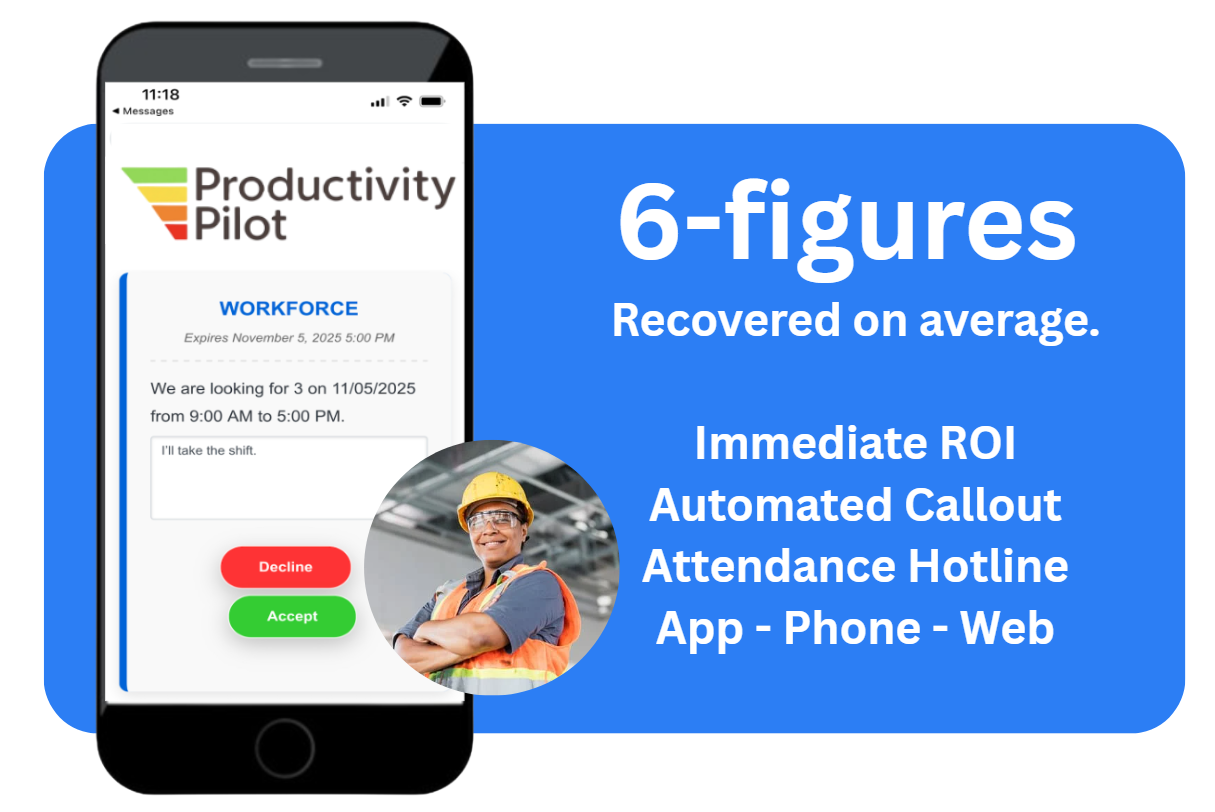
Productivity Pilot is the most complete absence management option on this list because it was designed to solve absence management as an operational problem. A lot of tools can log time off. Far fewer can reduce the downstream disruption created by call-offs and no-call no-shows across multiple sites.
Where Productivity Pilot Outperforms
- Multiple locations with different supervisors
- Call-offs routinely trigger overtime
- Attendance policy enforcement varies by manager
- Documentation quality matters for compliance or disputes
- Trend analytics tied to shifts and departments
If your workforce is hourly, deskless, or shift-based, Productivity Pilot is the strongest overall choice because it aligns absence management with operational stability. Learn more about how it compares in our call-off systems comparison.
TeamSense
TeamSense is best known for text-based call-offs. That solves a real adoption problem: frontline workers often do not want to download another app or log into a portal just to report an absence.
Strengths
- • Simple reporting workflow
- • Rapid manager notification
- • High adoption potential for deskless teams
Limitations to Watch
- • Policy automation depth varies by configuration
- • Deep escalation workflows may need additional layers
- • Operational dashboards may be less robust
TeamSense can be strong if your primary pain is "we cannot get employees to report absences cleanly." For teams that also need structured call-in procedures, consider how the system handles policy enforcement alongside intake.
BambooHR
BambooHR is primarily an HR platform. Its time-off features are solid for PTO management and visibility.
Strengths
- • User-friendly interface
- • HR suite functionality (records, onboarding, workflows)
- • PTO approvals and calendar visibility
Limitations for Shift-Based
- • Not built as a coverage response engine
- • Limited real-time absence escalation
- • More effective for planned leave than unplanned call-offs
If your workforce is primarily desk-based, BambooHR can be a good fit. If shift coverage is your primary problem, you will likely need a more operational system.
Workforce.com
Workforce.com is a workforce management platform often used for scheduling, compliance, and labor planning.
Strengths
- • Scheduling and labor forecasting
- • Compliance controls (overtime, rest rules)
- • Integrated view of attendance and scheduling
Limitations
- • Setup and configuration can be complex
- • Absence workflows may feel secondary to scheduling
- • Some organizations report a learning curve
This system is often best when the scheduling problem is bigger than the absence problem. For organizations where shift scheduling at scale is the primary challenge, it is worth evaluating.
TimeClock Plus
TimeClock Plus is strong for organizations that need structured time capture through hardware-based clock-in workflows.
Strengths
- • Hardware options for clock-in workflows
- • Compliance reporting
- • Attendance and leave tracking integrated with timekeeping
Limitations
- • Pricing is often quote-based and less transparent
- • Toolset can feel timekeeping-centric
- • Configuration may require stronger admin support
Paycom
Paycom is a full HCM suite that can be powerful for organizations trying to consolidate systems.
Strengths
- • Payroll + HR + time-off in one ecosystem
- • Standardization across locations
- • Strong compliance posture
Limitations
- • Cost and implementation complexity can be high
- • More system than many teams need just for absence management
- • Not always the fastest time-to-value
Calamari
Calamari is popular with teams that want flexibility and integrations (Slack, Google Workspace, Teams).
Strengths
- • Modular setup
- • Integrations with collaboration tools
- • Custom leave policies
Limitations
- • Advanced workflows may depend on tier
- • Operational dashboards may be limited
Timetastic
Timetastic focuses on time off scheduling and visibility with a clean, simple interface.
Strengths
- • Simple, clean interface
- • Fast implementation
- • Affordable pricing
Limitations
- • Limited attendance point automation
- • Not designed for real-time shift coverage response
LeaveBoard
LeaveBoard helps teams manage PTO, requests, and visibility as a step up from spreadsheets.
Strengths
- • Easy to get started
- • Calendar-driven visibility
- • Useful for small team coordination
Limitations
- • Limited escalation automation
- • Not an operational control platform for shift coverage
Spreadsheets (Excel / Google Sheets)
Spreadsheets are still widely used, but they do not scale.
| Capability | Dedicated System | Spreadsheets |
|---|---|---|
| Real-time alerts | Yes | No |
| Policy automation | Yes | No |
| Audit trail | Yes | Weak |
| Scales with headcount | Yes | No |
| Error-prone data entry | Low | High |
If you are using spreadsheets in a shift-based operation, the question is not "if" you will outgrow them. It is "how much damage occurs before you move on." Organizations that graduate from spreadsheets to structured attendance management systems typically see measurable improvements within weeks. To understand how much unplanned absences may already be costing you, start by learning how to calculate your absenteeism rate.
How to Choose the Right System for Your Workforce
Here is a decision framework that works in real environments.
1Identify Your Operational Risk Level
Ask: How many call-offs happen per week? How often do they trigger overtime? Do you have repeat patterns you cannot diagnose?
If absence impacts coverage, your solution must prioritize real-time alerts and enforcement.
2Assess Adoption Barriers
If your frontline employees resist portals and apps, frictionless reporting matters more than feature depth.
Adoption is the multiplier.
3Evaluate Policy Consistency Needs
If managers enforce rules differently across shifts or sites, policy automation becomes mandatory.
Consistency reduces exposure and improves morale. Learn more about structuring progressive discipline frameworks.
4Validate Documentation Requirements
If you operate in regulated industries, documentation and audit trails are not optional.
This is especially critical in healthcare and manufacturing environments where documentation and audit trails directly affect regulatory standing.
5Pilot with the People Who Will Use It
Include a frontline employee, a supervisor, HR, and operations leadership.
If any group struggles, scale will fail.
Implementation: How to Get Value Fast
Even the best absence management system fails if you roll it out poorly. Here is how to accelerate time-to-value.
Step 1: Define Your Attendance Policy in Clear, Automatable Rules
| Rule Category | Example |
|---|---|
| Points per event | 1 point for tardy, 2 points for absence |
| Rolling windows | 30/60/90-day rolling periods |
| Escalation thresholds | Coaching at 4, warning at 6, suspension at 8 |
| Exceptions | FMLA, protected leave, union rules |
| Documentation | Requirements for each discipline step, including warning letters |
Step 2: Standardize Supervisor Response Expectations
If the system alerts supervisors, define what "good response" looks like:
- • Who acknowledges the absence?
- • Who triggers coverage actions?
- • What is the escalation path?
For guidance on having productive conversations about attendance, see how to talk to employees about excessive absences.
Step 3: Start with One Location or Department
Prove the workflow, then scale. This approach reduces risk and builds internal credibility.
Step 4: Measure the Outcomes Leadership Cares About
Frequently Asked Questions
Final Takeaway: What Most Buyers Miss
Most buyers choose absence management systems based on features. High-performing organizations choose based on outcomes. If your workforce is shift-based and coverage-sensitive, you need a system that creates operational control, not just records. Understanding how HR impacts the bottom line helps frame the investment correctly.
Ready to See the #1 Absence Management System in Action?
Productivity Pilot aligns absence reporting, policy enforcement, escalation, documentation, and analytics into a unified operational workflow. If your goal is to stabilize coverage, reduce repeat call-offs, and enforce policy consistently, start here.
Explore related resources: absence management FAQs | no-fault attendance policies | avoiding policy issues
Editorial standards: This article is based on operational best practices and publicly available product information current as of February 2026. Rankings reflect fitness for shift-based, hourly, and multi-site workforce environments. Competitor names are used for informational comparison only.