
Scheduling Issues: How to Identify, Prevent, and Fix Coverage Gaps
Unreliable scheduling doesn't just cause confusion—it drives absenteeism, overtime, and burnout. This guide shows you how to eliminate scheduling issues using data-driven automation.
By Rich Titus
Unreliable scheduling doesn't just cause confusion—it drives absenteeism, overtime, and burnout. Whether you manage a manufacturing plant, a healthcare facility, or a logistics network, predictable staffing is what keeps operations stable. This guide walks you through the most common scheduling issues, why they happen, and how to eliminate them using data-driven automation.
Ready to simplify scheduling and reduce last-minute call-offs? Schedule a 20-minute demo to see how Productivity Pilot automates staffing accuracy and compliance tracking.
Why Scheduling Issues Cost More Than Lost Time
When schedules don't align with actual demand, the effects cascade across productivity, morale, and compliance. A single unfilled shift can trigger a chain reaction—delayed production runs, reduced service quality, and costly overtime. According to workforce studies, inconsistent scheduling can increase absenteeism by up to 50% and turnover by nearly 25%.
Behind every missed shift or double-booking is a deeper process gap—one that can usually be traced to either manual planning, poor visibility, or inconsistent communication.
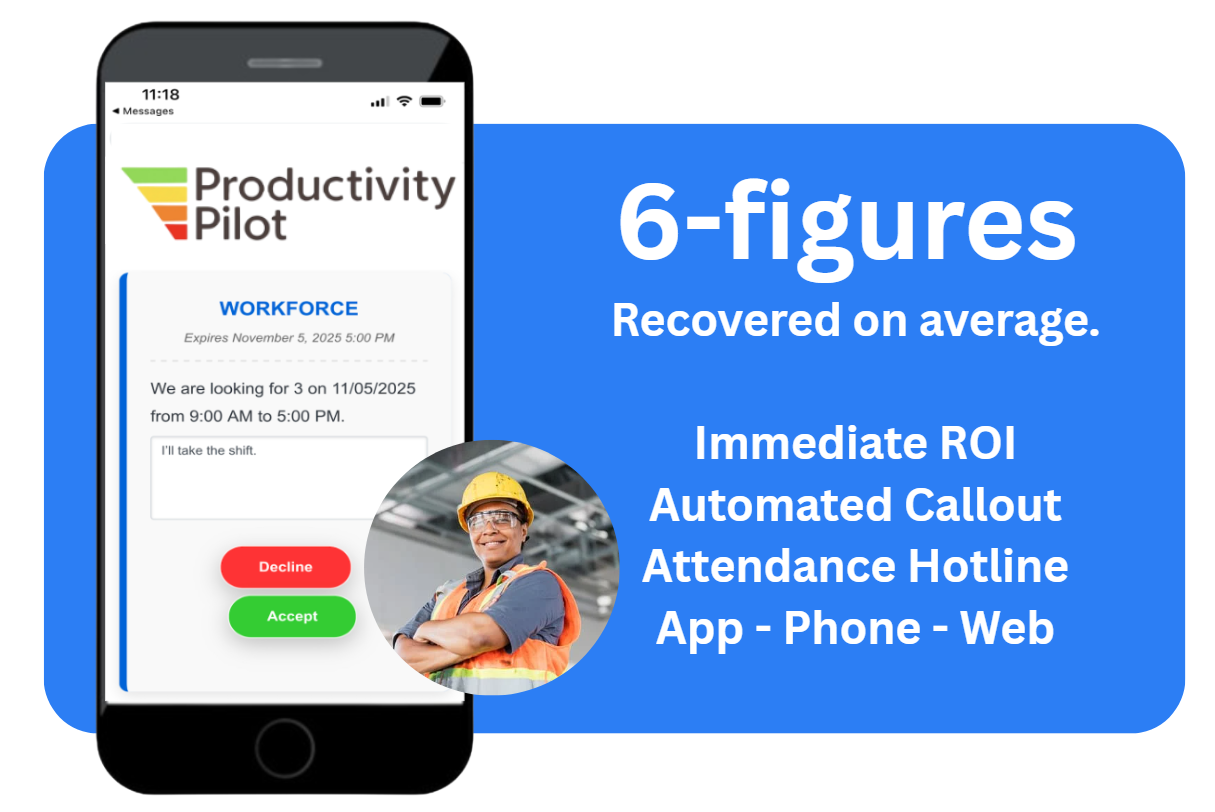
Common Scheduling Issues That Disrupt Operations
- Last-minute changes and no-shows. Without real-time communication tools, employees often miss schedule updates or can't confirm swaps quickly enough, leading to unplanned absences.
- Overstaffing or understaffing. Manual scheduling can't keep up with variable demand, resulting in wasted labor hours or gaps in coverage.
- Inconsistent shift assignments. When certain employees always get the same favorable shifts, morale and fairness take a hit.
- Poor visibility across departments. Decentralized scheduling means supervisors can't see conflicts or coverage gaps until it's too late.
- Compliance blind spots. Industries like healthcare and manufacturing must comply with fatigue, rest, and certification requirements—errors can result in fines or risk exposure.
- Time-off overlaps. When time-off requests aren't managed systematically, coverage suffers, and scheduling becomes reactive.
Root Causes of Scheduling Problems
- •Manual processes. Spreadsheets and text chains can't sync live data or update across shifts.
- •Disconnected systems. HR, timekeeping, and payroll tools that don't communicate create duplicate work and errors.
- •Outdated data. Forecasts built on old volume trends ignore seasonality, events, and real demand signals.
- •Lack of transparency. Employees who don't have access to their schedules or change notifications disengage and call off more often.
These issues compound when organizations operate across multiple sites or departments without a unified scheduling platform.
Operational and Cultural Impact of Poor Scheduling
The effects extend beyond the daily roster. Scheduling inefficiencies create ripple effects that harm both performance and culture:
- •Productivity loss: Shifts start late, handoffs fail, and throughput drops.
- •Higher overtime spend: Constant backfilling burns labor budgets.
- •Employee disengagement: Lack of predictability leads to frustration and attrition.
- •Compliance exposure: In regulated industries, fatigue and hour violations create legal risks.
- •Manager burnout: Supervisors spend more time patching schedules than managing performance.
How to Prevent Scheduling Issues Before They Start
Preventing coverage gaps starts with visibility, automation, and communication. Here's how leading operations teams are eliminating the guesswork:
- Centralize scheduling. Use one platform to manage all locations, shifts, and roles. Integrate timekeeping, leave, and staffing data to avoid overlap.
- Automate recurring patterns. Build templates for common schedules and shift rotations, reducing manual entry errors.
- Use demand forecasting. Analyze historical data and real-time trends to match labor to workload accurately.
- Enable employee self-service. Allow workers to view, swap, or claim open shifts via mobile app while maintaining manager approval workflows.
- Sync with leave management. Connect your scheduling tool to PTO and ESST systems to prevent accidental conflicts.
- Set communication protocols. Use standardized notifications and acknowledgments to confirm schedule changes.
Using Automation to Fix Scheduling Inefficiencies
Manual scheduling can't adapt to real-world changes fast enough. Automated workforce management tools streamline this by:
- •Predicting coverage needs by shift, role, and location
- •Flagging overtime risk before schedules are published
- •Automatically matching qualified employees to open shifts
- •Syncing attendance and point tracking frameworks to promote accountability
- •Ensuring compliance with union, fatigue, and rest-time regulations
Teams that adopt scheduling automation typically report lower absenteeism, improved on-time starts, and a measurable drop in overtime spending within 90 days. For specific tactics on reducing overtime, see our comprehensive 2026 guide.
Metrics to Measure Scheduling Performance
| Metric | Why It Matters | Target Benchmark |
|---|---|---|
| Schedule accuracy rate | Tracks how closely planned hours match actual worked hours | ≥ 95% |
| Overtime variance | Identifies cost impact of unplanned schedule gaps | < 10% variance |
| Employee shift swap rate | Measures flexibility and engagement | Moderate (10–20%) with proper controls |
| Unfilled shift rate | Shows scheduling efficiency and communication quality | < 3% of total shifts |
| Manager time spent scheduling | Operational efficiency indicator | < 10% of weekly hours |
Scheduling Best Practices by Industry
Manufacturing: Automate shift rotation, skill-based assignment, and machine coverage plans. See workforce management for manufacturing.
Logistics: Match staffing to delivery demand and vehicle routes to maintain delivery schedules with logistics attendance tracking.
Healthcare: Balance nurse-patient ratios and manage fatigue while maintaining patient coverage and compliance with healthcare attendance tracking. Learn more in our guide on improving healthcare productivity.
Education: Align schedules to academic calendars and optimize budgets and coverage during peak cycles.
FAQ: Scheduling and Workforce Optimization
How often should schedules be published?
At least two weeks in advance. Predictability reduces absenteeism and improves satisfaction. Automated tools can publish recurring schedules months ahead.
How do I handle frequent call-offs?
Pair your scheduling system with an attendance point policy to ensure accountability and visibility into call-off patterns.
What's the best way to manage last-minute changes?
Use digital notifications and self-service swaps to fill gaps quickly. Ensure only pre-qualified and rested employees can accept last-minute assignments.
How can I improve manager efficiency?
Automate 80% of repetitive scheduling tasks. Supervisors should focus on forecasting and coaching, not manual edits.
Take Control of Scheduling Before It Controls You
Scheduling issues don't solve themselves—they scale with complexity. The good news: automated workforce management platforms eliminate the guesswork by combining accurate forecasting, employee visibility, and compliance safeguards into one connected system.
Want to see how real-time scheduling automation reduces coverage gaps and burnout? Schedule a live walkthrough with Productivity Pilot today.