How to Avoid Issues with No-Fault Attendance Policies & Protect Productivity
Explore how no-fault attendance systems that lack structure and integration can expose your enterprise to legal, operational and productivity risks — and what modern absence-reporting systems unwind those risks.
No-fault attendance policies promise simplicity: a point for every absence, regardless of reason. But that "one-size-fits-all" model can backfire—opening enterprises to productivity loss, litigation risk, and administrative chaos. Organizations using no-fault policies without proper safeguards face significant compliance exposure and operational disruption. This guide gives you a modern blueprint for absence mitigation and policy resilience.
What Is a No-Fault Attendance Policy?
A no-fault attendance policy assigns a fixed number of occurrences or "points" for unplanned absences, tardiness, or early departures—often regardless of the reason. The idea: reward presence, penalize absence. Similar to attendance point systems, these policies track employee attendance through a quantifiable metric. But in its raw form, it doesn't differentiate between protected leave, emergencies, or full-shift illnesses.
True risk: when protected absences like Family and Medical Leave Act or Americans with Disabilities Act counts toward the same point-pool, compliance problems follow. Without proper policy automation, organizations risk costly legal violations.
Key Risks & Productivity Impact
Improperly designed no-fault policies create cascading problems across your organization:
- •Legal exposure: Counting protected absences can lead to ADA/FMLA violations. Organizations face wrongful termination lawsuits when policies penalize legally protected leave.
- •Hidden productivity drain: When employees fear losing points, they may work sick or unsafe—raising safety and output issues. This is particularly problematic in manufacturing and healthcare environments where safety is critical.
- •Administrative burden: Manually tracking points, exceptions, accommodations, and litigation risk ties up HR time. Without automated attendance tracking, administrative costs escalate rapidly.
- •Morale & turnover: Perceived unfairness increases disengagement, driving repeat absences and overtime costs. Similar to no-call no-show situations, poor policy design compounds absenteeism rather than reducing it.
Legal & Compliance Traps
Even well-intended attendance systems stumble when they treat all absences equally. Highlighted vulnerabilities:
- •Protected leave mis-counting: Employers that penalize FMLA/ADA absences via points risk termination challenges. Courts consistently rule against employers who fail to exempt protected absences from disciplinary systems.
- •Inconsistent application: If staff managers apply point systems unevenly, the risk of disparate treatment claims increases. Manual tracking creates opportunities for favoritism and discrimination.
- •Policy ambiguity: Employers must clearly communicate exceptions and process through standardized call-in procedures; vague policy equals exposure.
Compliance reality check: Organizations in logistics, food & beverage, and retail face heightened scrutiny due to high-volume hourly workforces and rapid turnover.
Best Practices to Mitigate Risk
Transform your no-fault policy from liability to asset with these five essential practices:
- 1
Segment absences: Separate protected leave, scheduled time off and unscheduled call-offs into distinct tracking categories.
- 2
Standardize call-off intake: Use an absence-reporting system that timestamps, categorizes and routes absences accurately.
- 3
Automate integrations: Connect your system to HRIS, scheduling and payroll to ensure accuracy and audit trails.
- 4
Train supervisors & embed policy: Make sure managers understand legal triggers (ADA, FMLA) and escalation workflows.
- 5
Review & iterate: Audit your point system quarterly—evaluate if it penalizes protected absences or lacks fairness.
Quick Implementation Checklist:
- ✅Define categories for leave (annual, sick, personal, FMLA/ADA)
- ✅Implement a centralized hotline/portal for absences
- ✅Configure automatic flags for protected leave
- ✅Map to integrations (HRIS/WFM) to avoid manual errors
- ✅Run quarterly audits on point-assessments and terminations
Technology & Absence-Reporting Systems
A modern absence-reporting system is the backbone of compliance and productivity. Organizations leveraging automated solutions see 30-50 percent reduction in unplanned absences while eliminating manual tracking errors.
Productivity Pilot's platform provides comprehensive absence management capabilities:
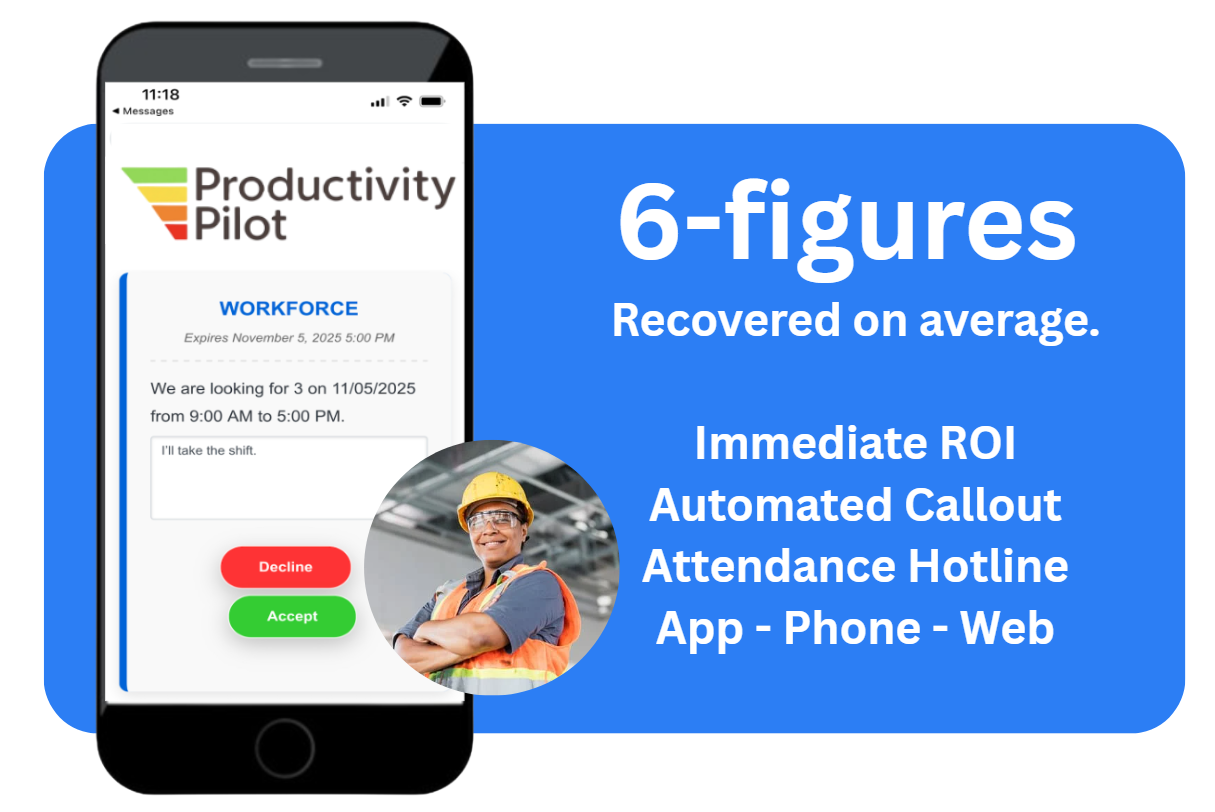
- •24/7 intake: Live agents plus IVR capture call-offs in real time through multi-channel communication.
- •Reason-code capture: Logs absence cause, shift, expected return, and contact info for complete documentation.
- •Multilingual support: Scale across global workforce—up to 150 languages for clarity and fairness, critical for diverse workforces in education and healthcare.
- •Integration layer: Error-free handoffs to HRIS, payroll, and scheduling systems prevent the manual data entry mistakes that create compliance risk.
- •Analytics & alerts: Dashboards highlight spikes in unscheduled absence, point accumulation trends, and site risk zones.
Business Impact:
- •30-50 percent reduction in unplanned absences within 6 months
- •80 percent reduction in HR administrative time managing attendance
- •Zero point calculation errors through automated tracking
- •Complete audit trails for wrongful termination defense
Enterprise Checklist
Use this checklist to audit your current no-fault attendance policy and identify gaps:
- ✅Validate your current attendance policy doesn't penalize protected absences.
- ✅Ensure your absence-reporting system logs time-stamps and reason codes.
- ✅Implement multilingual and mobile-friendly access for your workforce.
- ✅Connect your system indicators to HRIS/WFM to automate data flow.
- ✅Schedule regular audits and update policy language quarterly.
- ✅Train managers on protected absence categories and escalation procedures.
- ✅Review termination data to identify patterns of protected absence violations.
FAQs
What is considered a "protected absence"?
Protected absences may include qualifying leave under the FMLA, ADA-required accommodations, pregnancy, jury duty, military service, or state/local paid sick-leave laws. Employers must exclude these from point systems to avoid interference and discrimination claims.
Can we still use a point-based system at all?
Yes—but only if you design it to exclude protected absences, apply it consistently, and embed audit trails for discrimination risk mitigation. Automated systems like Productivity Pilot ensure protected absences are flagged before points are assigned.
How do we audit our policy for risk?
Review recent terminations under the policy, check if protected absences were counted, and validate documentation and manager training. Look for patterns of terminations following FMLA usage or ADA accommodations—these indicate compliance gaps.
What if our workforce is global and uses many languages?
Ensure your absence-reporting system supports multilingual intake and mobile-access so employees understand how to comply—language barriers increase mis-classification risk. Productivity Pilot supports up to 150 languages for workforce accessibility.
What productivity metrics should we monitor?
Track unscheduled absence rates, overtime hours paid, coverage gaps, and point-accumulation trends by site or shift. These feed into your mitigation dashboard and help identify problem areas before they escalate.
Key Takeaways
- •No-fault attendance policies without structure are high-risk for productivity and compliance.
- •The right absence-reporting system (with multilingual scale and integrations) transforms policy into insight and control.
- •Policy plus process plus technology equals fewer admin hours, lower legal exposure, and reduced downtime.
- •Automated systems prevent the protected absence violations that lead to costly litigation.
Next Steps
Get ahead of absenteeism and ensure your attendance policy supports productivity—not liability. Productivity Pilot's absence management platform eliminates manual tracking errors while ensuring FMLA and ADA compliance.