
No-Fault Attendance Policies: Balancing Operational Needs with Legal Compliance
A practical framework for implementing no-fault systems that reduce absenteeism without exposing your organization to FMLA, ADA, and discrimination claims.
No-fault attendance policies were designed as a win-win: employees gained flexibility to take time off without explaining personal reasons, while employers gained objective metrics to address chronic absenteeism. The concept seemed straightforward—accumulate too many points, face discipline. No excuses needed, no judgment involved.
But implementation revealed a critical flaw: no-fault systems that fail to account for legally protected absences create significant compliance risk. Organizations have faced successful lawsuits for penalizing employees who took FMLA-protected leave, ADA-accommodated absences, or other legally safeguarded time off. This guide shows how to structure compliant no-fault policies that work alongside attendance point systems while protecting against legal exposure.
What Is a No-Fault Attendance Policy?
A no-fault attendance policy assigns points to absences and tardiness regardless of the reason. Employees accumulate points over time, triggering progressive discipline as thresholds are exceeded—from verbal warnings to termination.
The "no-fault" principle means employees don't need to provide excuses or justify absences. The policy focuses on the fact of the absence, not the cause. Effective policy automation ensures these systems operate consistently across manufacturing, healthcare, and other shift-critical industries.
Critical distinction: While "no excuse needed" simplifies administration, federal and state laws still require exemptions for legally protected absences—FMLA, ADA accommodations, workers' comp, and state-mandated sick leave.
Why No-Fault Policies Create Legal Risk
The fundamental problem: federal and state laws prohibit penalizing employees for protected absences, even under "no-fault" systems. Organizations cannot assign points or take disciplinary action for absences related to:
- •FMLA: Employee's serious health condition, care for family member, childbirth/adoption, military family leave.
- •ADA: Absences related to approved reasonable accommodations, disability treatment, recovery from procedures.
- •Workers' Compensation: Time off for work-related injuries during approved treatment.
- •State/Local Protected Leave: Sick leave laws, domestic violence leave, voting leave, jury duty.
The compliance trap:
If your system automatically assigns points to all absences without flagging protected categories, you're creating documentation of illegal discrimination—even if unintentional. This exposure exists whether you later remove the points or not.
Common Implementation Errors That Create Liability
Beyond failing to exempt protected absences, organizations make several operational mistakes:
- •Inconsistent Application: Managers give "breaks" to favored employees—creating discrimination exposure.
- •Inadequate Documentation: Handwritten logs and incomplete records make disciplinary defense impossible.
- •Manual Calculation Errors: Spreadsheet mistakes result in wrongful termination based on inaccurate data.
- •Failure to Train Managers: Supervisors assign points to FMLA/ADA absences incorrectly.
- •No Employee Transparency: Workers can't view point totals, creating perception of unfair treatment.
Building a Compliant No-Fault Attendance Policy
To implement no-fault systems that withstand legal scrutiny, organizations must build in protections from the start:
- 1
Clearly Define Protected Absence Exemptions
Policy language must explicitly state which absence types do not accrue points (FMLA, ADA, workers' comp) and verification requirements.
- 2
Implement Dual-Track Systems
Operational tracking (for coverage) separate from compliance review (for protected status determination).
- 3
Build in Notification Workflows
At call-off, prompt employees about potential protected status; place points in "pending" until HR reviews.
- 4
Provide Manager Training
Annual training on recognizing protected absences and when to escalate to HR.
- 5
Enable Employee Transparency
Self-service access to point totals, absence history, and protected leave status reduces disputes.
Technology: The Compliance Safety Net
Manual no-fault systems—spreadsheets, paper logs, memory-based tracking—cannot consistently identify protected absences or prevent calculation errors. Automated absence management platforms eliminate these vulnerabilities:
- •Protected absence flagging: System prompts employees to indicate potential protected status at call-in.
- •Pending point status: Points held until HR confirms protected status—preventing premature discipline.
- •HR review workflows: Flagged absences route to HR dashboard for documentation review.
- •Automated point removal: Once protected status confirmed, system retroactively removes points.
- •Audit trails: Every assignment, adjustment, and determination is timestamped and logged.
Productivity Pilot: Compliant No-Fault Policy Automation
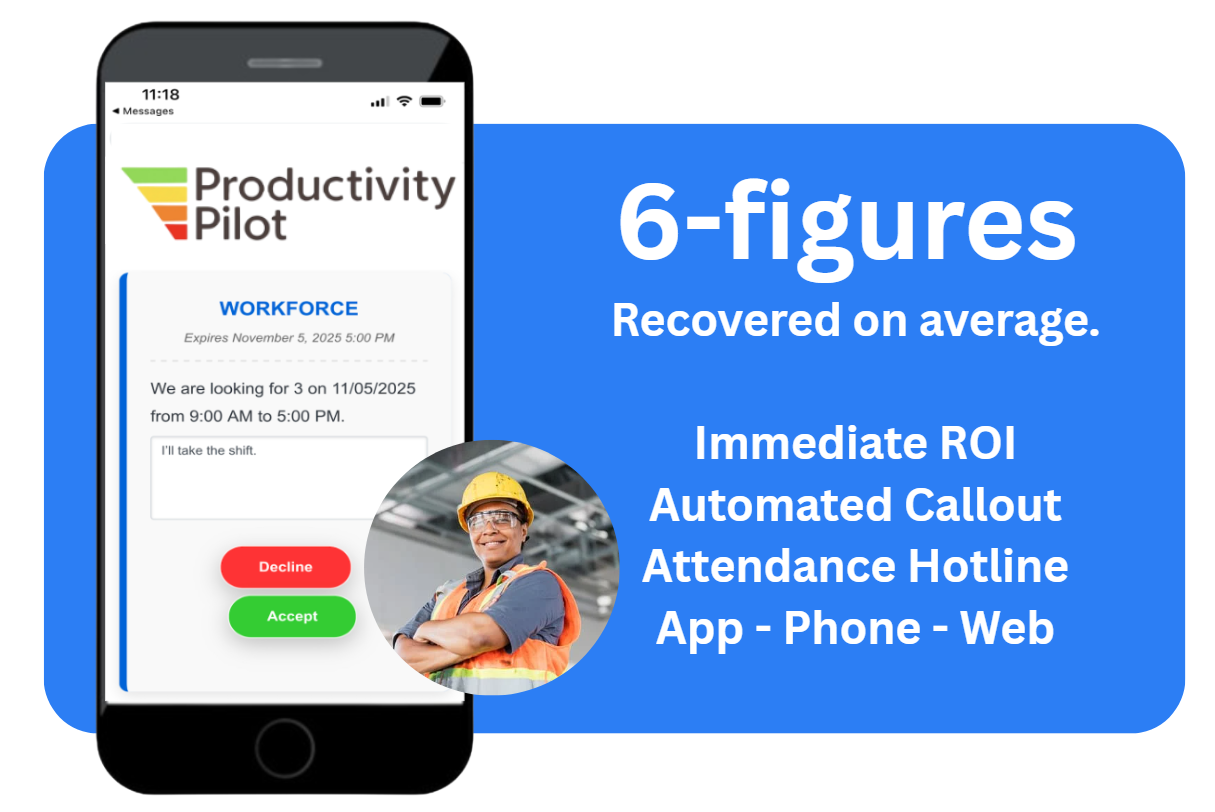
Productivity Pilot's absence management platform provides comprehensive no-fault policy automation with built-in compliance protections that prevent FMLA, ADA, and discrimination violations.
How Productivity Pilot Ensures Compliance
- ✅24/7 Call-Off Hotline: Employees report via phone, text, or web portal—capturing every absence consistently.
- ✅Protected Absence Prompts: At call-off, system asks about FMLA, ADA, workers' comp, or other protected leave.
- ✅Conditional Point Assignment: If protected status indicated, points placed in "pending"; HR notified for review.
- ✅Automated Point Adjustments: Once HR confirms protected status, system retroactively removes points—no manual edits.
- ✅Audit-Ready Documentation: Every absence, assignment, and adjustment timestamped and stored.
Business Impact:
- •Reduced legal risk through automated protected absence flagging
- •60-80 percent reduction in HR time managing point calculations
- •Complete documentation trail for wrongful termination defense
FAQs
Can we have a no-fault policy and still comply with FMLA/ADA?
Yes—but only if you exempt protected absences from point accumulation. The policy can be "no-fault" for general absences while maintaining separate tracking for legally protected leave.
What happens if we assign points to FMLA leave by mistake?
Remove the points immediately and document the correction. Even accidental point assignment creates evidence of interference. Automated systems prevent this by flagging potential protected absences before finalizing points.
How do we handle employees who claim every absence is FMLA-protected?
Request medical certification with frequency estimates. If absences exceed certified frequency or don't match the described condition, request recertification. You can question validity—but cannot deny legitimate FMLA use.
Can managers override point assignments for exceptional circumstances?
No—manager discretion defeats the purpose of objective, consistent enforcement. Only HR should adjust points, and only for legally protected absences. All other adjustments create favoritism risk.
What's the biggest compliance mistake with no-fault policies?
Automatically assigning points to all absences without HR review for protected status. This creates interference claims even if you later remove the points. Dual-track systems (operational reporting + compliance review) prevent this exposure.
Key Takeaways
- •No-fault policies create legal risk when protected absences (FMLA, ADA) are penalized—even unintentionally.
- •Manual systems cannot reliably flag protected absences or prevent calculation errors.
- •Compliant policies require dual-track systems: operational reporting + HR review before finalizing points.
- •Technology platforms eliminate compliance gaps through automated flagging and conditional point assignment.
Next Steps
Ready to implement a no-fault attendance policy that reduces absenteeism without exposing your organization to FMLA and ADA violations?