Employee Call-In Procedures: Policy, Templates & Compliance (2025)
A practical, enterprise-grade framework to standardize employee call-ins, protect throughput, and reduce productivity loss—backed by multilingual access and system integrations.
Ad-hoc call-ins create noise, drag supervisors off the floor, and drive expensive overtime. A disciplined, well-communicated employee call-in procedure is the operating control that keeps schedules predictable and production stable. When combined with effective no-call no-show policies and robust attendance tracking systems, proper call-in procedures form the foundation of workforce reliability. This guide consolidates policy language, workflows, and templates you can deploy fast—then scale globally with multilingual support.
What Are Employee Call-In Procedures?
Employee call-in procedures are documented rules that define how, when, and to whom an employee reports an absence or tardiness. They set the reporting window (e.g., two hours before shift), the approved channels (hotline, IVR, portal), the data to capture (reason codes, expected return), and the notification/escalation path to leadership. Modern answering services can provide 24/7 call-in support, ensuring employees can always reach someone when reporting an absence.
Objective: eliminate ambiguity, compress response time, and ensure every event is captured with audit-ready detail.
Core Policy Components
Effective call-in procedures must integrate with your broader policy automation framework to ensure consistent enforcement. Industries like manufacturing and healthcare require especially robust procedures given their shift-critical operations. Professional phone etiquette training should also be provided to anyone handling call-ins to ensure consistent, respectful communication.
- •Reporting Window: required notice period before shift start; exceptions (emergencies).
- •Approved Channels: 24/7 hotline (live agent/IVR), mobile portal; no manager voicemails or texts.
- •Required Information: employee ID, shift time, reason code, expected return, contact method.
- •Reason Codes: illness, family emergency, transportation, weather, approved leave, other.
- •Notifications: instant alerts to supervisor/HR; optional union or safety contacts if applicable.
- •Verification: documentation rules (e.g., medical note after X days), local legal alignment.
- •Accountability: progressive discipline for non-compliance, with HR oversight.
- •Accessibility: multilingual coverage (target: 150 languages) and ADA accommodations.
Standard Call-In Workflow
- 1Employee reports via hotline/portal within the defined window.
- 2System captures time-stamp, identity, reason code, expected return, contact details.
- 3Automatic notifications go to supervisor/HR; staffing dashboard updates in real time.
- 4Coverage decision is triggered—overtime, float pool, or agency backfill.
- 5Compliance record is retained for audits, payroll, and trend analysis.
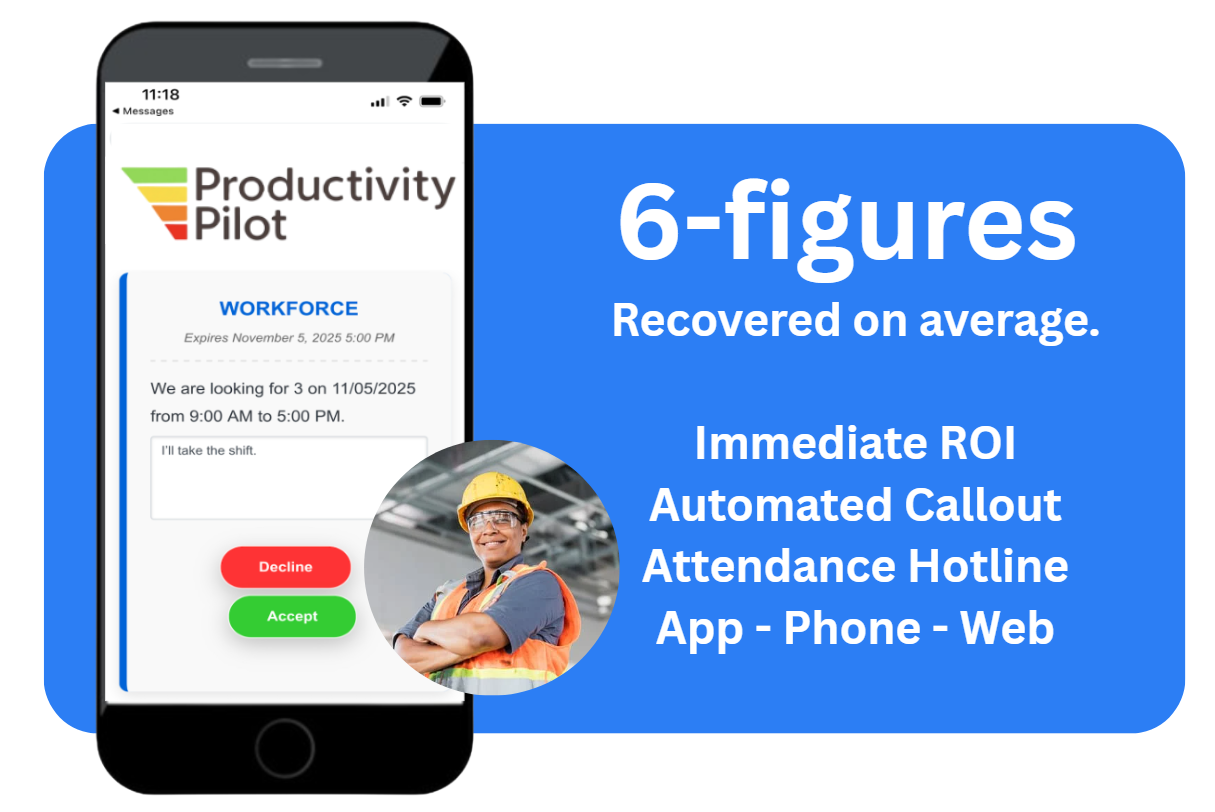
Blending live agents + IVR ensures accuracy at volume, while integrations push data to HRIS/WFM without manual swivel-chair work.
Templates & Scripts
Policy Language (Sample)
Employee Script (Hotline/IVR)
Supervisor Notification (Automated)
Compliance & Risk Controls
- •Documentation: consistent time-stamped logs for grievances, audits, and payroll reconciliation.
- •Privacy: minimum-necessary data handling; align with HIPAA (where applicable) and SOC 2 controls.
- •Fairness: uniform application of policy across roles and shifts; reasonable accommodations.
- •Retention: policy-defined retention schedules; legal hold support.
Bottom line: disciplined call-in processes reduce disputes and create defensible records.
Technology & Integrations
A modern stack avoids manual friction and error:
- •24/7 Call-In Hotline: live agents + IVR for scale and accuracy.
- •Multilingual Natively: up to 150 languages across voice and portal.
- •HRIS/WFM Integrations: APIs/SFTP for PeopleSoft, Workday, UKG, ADP, etc.
- •Analytics: reason-code trends, heatmaps by site/shift, forecasted risk.
- •Alerting: email/SMS/Slack/Teams for supervisors and on-call rotations.
Rollout & Training Checklist
- ✅Finalize policy language; union/legal review as needed.
- ✅Configure hotline/IVR and employee portal; test multilingual flows.
- ✅Map integrations to HRIS/WFM; validate reason codes and payroll impacts.
- ✅Train supervisors on notifications, coverage playbook, and documentation.
- ✅Communicate to employees via toolkits (posters, wallet cards, QR codes).
- ✅Launch with grace period; monitor adherence; iterate scripts.
FAQs
Why disallow texts/voicemails to managers?
They're unreliable, non-standard, and hard to audit. Centralized channels create a single source of truth and faster response.
How does multilingual support change outcomes?
It eliminates miscommunication, improves timeliness, and increases adherence—directly reducing downtime.
What's the ROI of standardizing call-ins?
Fewer missed notifications, faster coverage decisions, lower overtime, and better forecasting—compounding savings at scale.
How quickly can we deploy a hotline + portal?
Hotline and notifications in days; integrations and policy tuning in subsequent weeks.
Can we tailor reason codes and escalation paths by site?
Yes—site/role/union-specific flows are configurable while maintaining global policy consistency.
Key Takeaways
- •Call-in procedures are an operating control—not paperwork.
- •Centralized channels + multilingual access = faster, cleaner, auditable capture.
- •Integrations and analytics turn call-ins into actionable staffing intelligence.
Next Steps
Ready to move from ad-hoc to disciplined?