
Attendance Point Systems: The 2025 Framework for Fair, Defensible Absence Management
A practical guide to designing, implementing, and automating no-fault attendance policies that reduce absenteeism, ensure compliance, and eliminate subjective discipline.
Unplanned absences cost organizations an average of $3,600 per hourly employee annually through overtime, replacement labor, and productivity loss. Traditional attendance policies—manager discretion, subjective "excuses," inconsistent enforcement—compound the problem by creating compliance risk and employee distrust.
Attendance point systems solve this by establishing objective, transparent consequences for absenteeism. Employees accumulate points for each absence or tardiness, triggering progressive discipline at defined thresholds—eliminating manager subjectivity and ensuring consistent enforcement. This guide explores how to design and automate point systems that reduce absenteeism while protecting against FMLA, ADA, and discrimination claims.
What Is an Attendance Point System?
An attendance point system (also called a no-fault attendance policy) assigns numerical points to absences and tardiness based on the type and duration of the event—not the reason. Points accumulate over a rolling period (typically 6-12 months), and employees face progressive discipline as they reach defined thresholds.
The "no-fault" principle means employees don't need to provide excuses or justify absences. The policy focuses on the fact of the absence, not the cause. This approach offers several advantages:
- •Employee privacy: Workers aren't forced to disclose personal medical details.
- •Simplified administration: Managers don't evaluate "validity" of excuses.
- •Objective enforcement: Points accumulate mathematically, creating clear consequences.
- •Predictable outcomes: Employees know exactly what happens at each threshold.
Critical compliance note: Point systems must exempt legally protected absences (FMLA, ADA, workers' comp) to avoid interference claims. Technology platforms automate these protections.
Why Organizations Implement Point Systems
Effective attendance tracking becomes especially critical in shift-based industries like manufacturing, healthcare, and logistics. Point systems address five key operational challenges:
- 1
Reduce Chronic Absenteeism:
Organizations using point systems report 30-50 percent reduction in unplanned absences within 6 months. Clear consequences deter habitual call-offs.
- 2
Eliminate Manager Subjectivity:
Automated point assignment removes manager discretion, preventing favoritism and discrimination claims.
- 3
Create Defensible Documentation:
Complete timestamped records support wrongful termination defense and unemployment claim responses.
- 4
Improve Employee Accountability:
Real-time point visibility promotes self-management and reduces disputes about discipline.
- 5
Lower Operational Costs:
Reduced absenteeism translates to lower overtime expenses, fewer replacement hires, and improved throughput.
Structuring Your Point System: Five-Step Framework
Step 1: Define Point Values
Assign points based on absence type and advance notice:
| Event Type | Points |
|---|---|
| Tardy (late arrival or early departure) | 0.5 points |
| Unplanned absence (full shift) | 1 point |
| No-call no-show | 3 points |
| Protected absence (FMLA, ADA, workers' comp) | 0 points |
Step 2: Set Rolling Calculation Period
Most organizations use a 6-month or 12-month rolling window. Points assigned more than X months ago fall off automatically, allowing employees to reset their record through consistent attendance.
Step 3: Establish Disciplinary Thresholds
| Point Total | Consequence |
|---|---|
| 3 points | Verbal warning |
| 5 points | Written warning |
| 8 points | Final warning (probation) |
| 10 points | Termination |
Step 4: Build in Positive Reinforcement
Recognize good attendance to balance the punitive focus:
- •Point removal: Subtract 1 point for every 30 days of perfect attendance.
- •Attendance bonuses: Quarterly rewards for employees below threshold.
- •Recognition programs: Public acknowledgment of attendance streaks.
Step 5: Exempt Protected Absences
Critical compliance requirement:
Absences protected under FMLA, ADA reasonable accommodations, workers' compensation, or state sick leave laws CANNOT accrue points. Failure to exempt these absences creates legal liability for interference and discrimination claims.
Implementation Best Practices
Successful point system rollouts require clear communication, consistent enforcement, and automated policy enforcement:
- •Policy transparency: Publish point values, thresholds, and protected absence exemptions in employee handbook.
- •Manager training: Ensure supervisors understand they cannot override point assignments or create exceptions.
- •Employee self-service: Provide real-time access to point totals and absence history.
- •Threshold alerts: Notify employees when approaching disciplinary triggers.
- •Audit trails: Maintain complete documentation of point assignments and adjustments.
Technology: Automating Point System Tracking
Manual point tracking—spreadsheets, paper logs, manager memory—creates calculation errors, inconsistent enforcement, and compliance gaps. Automated absence management platforms eliminate these risks:
- •Automatic point assignment: System calculates points immediately when employee reports absence via standardized call-in procedures.
- •Protected absence flagging: FMLA/ADA absences marked separately; points placed in "pending" status until HR reviews.
- •Rolling window calculations: Points automatically expire based on policy-defined timeframe.
- •Employee transparency: Self-service portals display current point total, absence history, and next threshold.
- •Manager dashboards: Real-time visibility into team attendance patterns and individual risk levels.
- •Automated workflows: Threshold alerts trigger supervisor notifications and HR review processes.
Productivity Pilot: Automated Point System Management
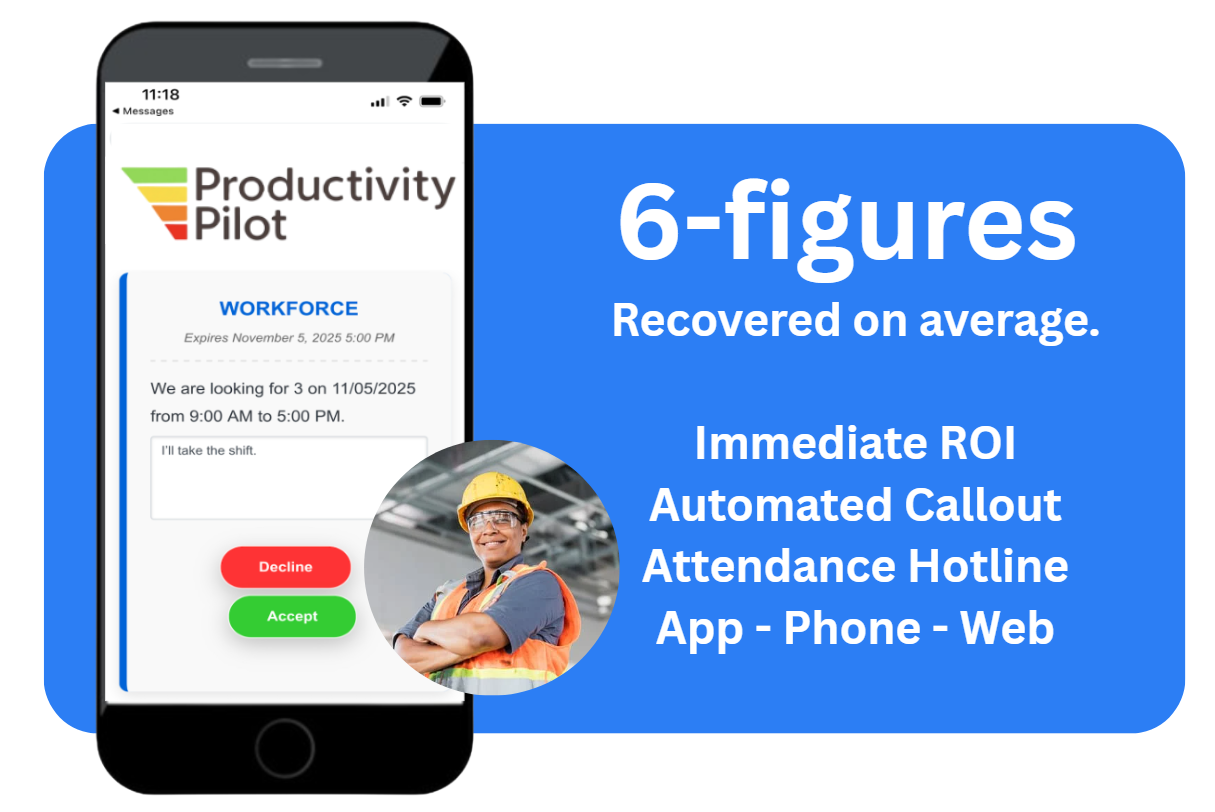
Productivity Pilot's absence management platform provides comprehensive point system automation with built-in compliance protections—eliminating manual tracking errors while reducing absenteeism.
Key Features
- ✅24/7 Call-In Hotline: Employees report absences via phone, text, or web portal—system assigns points automatically.
- ✅Protected Absence Workflows: FMLA/ADA flagging prevents premature point assignment for legally protected leave.
- ✅Rolling Window Calculations: Points expire automatically based on policy-defined timeframe—no manual adjustments.
- ✅Employee Self-Service Portal: Real-time point totals, absence history, and threshold proximity.
- ✅Threshold Alerts: Automated notifications to employees and managers when approaching discipline triggers.
- ✅HRIS Integration: Seamless data flow to Workday, UKG, ADP, PeopleSoft for payroll and benefits.
Business Impact:
- •30-50 percent reduction in unplanned absences within 6 months
- •80 percent reduction in attendance-related HR administrative time
- •Zero calculation errors or missed threshold notifications
Common Challenges & Solutions
Challenge: Employees perceive point systems as punitive or unfair
Solution: Balance discipline with positive reinforcement. Offer point removal for perfect attendance periods, attendance bonuses, and public recognition. Communicate that the policy eliminates manager favoritism and creates fairness.
Challenge: Manual tracking creates calculation errors and disputes
Solution: Automate point assignment and tracking. Systems eliminate spreadsheet errors, provide timestamped audit trails, and give employees real-time visibility to reduce disputes.
Challenge: Protected absences (FMLA, ADA) create compliance risk
Solution: Implement dual-track systems. All absences are reported for operational coverage, but HR reviews flagged absences before points are finalized. Automated workflows prevent FMLA/ADA absences from accruing points.
Challenge: Managers try to override point assignments for favored employees
Solution: Remove manager discretion entirely. Automated systems assign points based on policy rules—managers cannot adjust totals. HR handles exceptions only for legally protected absences.
Challenge: Employees game the system (e.g., multiple partial absences instead of full days)
Solution: Calibrate point values to discourage gaming. For example, assign 0.5 points per tardy instance, but cap at 1 point per day regardless of number of late arrivals. Monitor patterns and adjust policy as needed.
FAQs
What is the difference between a no-fault attendance policy and a point system?
They're the same. "No-fault attendance policy" and "point system" both refer to policies that assign points based on the fact of absence—not the reason. The term "no-fault" emphasizes that employees don't need to justify absences.
Can we use different point values for different departments?
Yes—but ensure the rationale is defensible. For example, higher point penalties for safety-sensitive roles (manufacturing, healthcare) may be justified. Document the business reason to avoid discrimination claims.
Should we use a 6-month or 12-month rolling window?
12-month windows are more common and provide longer-term accountability. 6-month windows allow employees to reset faster, which may be appropriate for organizations with seasonal turnover or hiring challenges.
How do we handle employees who reach termination threshold during peak season?
Consistency is critical. If you make exceptions for high performers or peak periods, you create discrimination risk. Instead, consider implementing probation periods or alternative consequences before termination.
What's the biggest mistake organizations make with point systems?
Failing to exempt protected absences (FMLA, ADA, workers' comp). Even unintentional point assignment for legally protected leave creates interference claims. Automated systems prevent this by flagging potential protected absences before finalizing points.
Key Takeaways
- •Point systems reduce absenteeism 30-50 percent by creating objective, transparent consequences for attendance.
- •Automated point tracking eliminates calculation errors, manager subjectivity, and compliance gaps.
- •Protected absences (FMLA, ADA) MUST be exempted from point accumulation to avoid legal liability.
- •Employee transparency and positive reinforcement balance punitive focus and promote accountability.
Next Steps
Ready to implement a point system that reduces absenteeism while protecting against compliance risk?