
Talking to Employees about Excessive Absences
A practical playbook for operations and HR leaders to address excessive employee absenteeism with clarity, consistency, and compliance—while protecting productivity and margins.
Reduce absenteeism before the hard conversations
Productivity Pilot helps frontline leaders spot patterns early, rebalance shifts, and cut unplanned absences by up to 50% across workforce management for manufacturing, time-critical logistics operations, and other shift-based environments.
What counts as excessive absenteeism? Definition + context
Some absenteeism is unavoidable. People get sick, kids have emergencies, schools close, and public transit breaks. A healthy operation accounts for this baseline and still delivers on production targets, patient coverage, or delivery windows.
Excessive absenteeism is different. It is a pattern of missed work, late arrivals, or last-minute call-offs that sits above your normal baseline and disrupts operations, team morale, and customer service. Many organizations use a concrete trigger, such as multiple unexcused absences in a 30-day period, but the operational impact is what really matters.
If a single employee's absences routinely cause overtime spikes, shift reassignments, or coverage gaps in critical functions—on the line, in the warehouse, or on the floor of a healthcare unit—you are dealing with excessive absenteeism, even if the policy language is vague.
Excused vs. unexcused absences: navigating the spectrum
Before you sit down with an employee, you need a clear lens for how your organization defines attendance events. That starts with a disciplined distinction between excused and unexcused absences and a documented way to track both.
Excused absences: when time off is reasonable
Excused absences are those already anticipated or specifically protected by policy or law—scheduled PTO, jury duty, protected leave, or a documented medical event. In most organizations, these are banked in a leave management or attendance point system that makes the rules visible and predictable.
Your employee conversation should rarely center on excused absences alone. Instead, they provide important context: Is the employee using time off as designed, or clustering protected leave in ways that strain a particular line, facility, or route?
Unexcused absences: when the pattern becomes a problem
Unexcused absences are missed shifts, late arrivals, or early departures with no valid reason or without following the call-off process. These are the events that tend to be invisible in spreadsheets and painfully obvious on the floor.
When unexcused events stack up—no-call no-shows, last-minute texts to a supervisor, or missed handoffs between shifts—they cascade into overtime, rework, and delayed orders. For a logistics operation trying to maintain delivery schedules or a manufacturing plant running lean staffing, this quickly becomes a material margin problem.
Balancing flexibility with attendance discipline
The goal is not to penalize every unexpected absence. The goal is to build a system where employees understand what is expected, leaders have real-time data, and everyone trusts that attendance rules are applied consistently.
That usually requires:
- •A written policy that defines excused and unexcused attendance events.
- •A consistent, automated way to log every call-off, late arrival, and early departure.
- •Clear thresholds for coaching conversations, formal warning letters, and final decisions.
- •Alignment with HR, legal, and your privacy policy and terms of service when data is used in employment decisions.
Are back-to-back vacation and sick days a red flag?
Back-to-back vacation and sick days are not automatically excessive absenteeism. Employees will occasionally get sick at the end of a scheduled break or have legitimate issues that extend their time away from work.
What matters is the pattern. If you consistently see employees extending holidays or peak vacation windows with "sick" days that leave a production line, classroom, or care unit exposed, that is a signal to review both policy and scheduling. This is where automated attendance data and coverage optimization for education and public sector teams can protect budgets and continuity.
How to identify excessive absences in the workplace
You cannot have a productive conversation about absenteeism if your data is scattered across voicemail, text threads, and paper forms. Excessive absenteeism should be identified through a consistent lens, not gut instinct.
A practical approach:
- •Define a baseline absence rate by site, role, and shift over a 6–12 month period.
- •Flag employees whose unexcused events or total absence hours exceed that baseline by a specific threshold.
- •Look for clustering around weekends, holidays, overtime assignments, or less desirable shifts.
- •Layer in operational impact: missed production targets, delayed discharges, or rescheduled deliveries.
In a modern workforce management environment, this analysis should be automated. Productivity Pilot surfaces high-risk patterns for frontline leaders across patient coverage and compliance, manufacturing, logistics, and other critical operations—so conversations are grounded in facts, not frustration.
Baking attendance expectations into your employee handbook
If your attendance expectations live only in manager memory, you will struggle to have defensible, productive conversations about absenteeism. The employee handbook is where you codify the rules of the game.
At minimum, your handbook should:
- •Define regular attendance as an essential job function for role types that require on-site presence.
- •Explain how to report an absence, who to notify, and by what time.
- •Clarify how excused and unexcused events are tracked and how points or infractions accumulate.
- •Outline the steps from coaching to corrective action, including potential termination.
- •Reference how your policies interact with leave laws and accommodations obligations.
For multi-site operations—especially in multi-plant manufacturing networks or large healthcare systems—leaders should also ensure that local site practices match written policy. The cleanest policy in the world will not help if supervisors are "making exceptions" in ways that undermine fairness and increase legal risk.
How to talk to employees about chronic absenteeism
Once you have identified a pattern, aligned on policy, and confirmed your data, you still have to do the hard part: sit down with the employee. That conversation sets the tone for everything that follows—performance, engagement, and, if necessary, separation.
Use these six steps as a repeatable framework for managers and supervisors across sites and shifts.
1. Anchor the conversation in clear policies and procedures
Start by restating expectations, not accusations. Reference the attendance section of your handbook, the call-off procedure, and any relevant points or infractions system. Make it clear you are applying the same standard used for every employee in a similar role.
This approach protects both sides. The employee understands that expectations were documented from day one, and you avoid ad-hoc decisions that could be perceived as unfair or discriminatory later.
2. Diagnose the root cause, not just the missed shift
Excessive absenteeism is a symptom. The root cause might be unreliable transportation, care responsibilities, health conditions, burnout, or a culture issue on a specific team. You will not know unless you ask.
Create space for the employee to explain what is driving their absences. Ask open, job-related questions and stay away from topics that could cross legal lines. When in doubt, route questions and potential accommodations through HR and your legal team, and point leaders to your implementation and support FAQs so they know how the system supports documentation and compliance.
3. Address patterns in real time, not once a quarter
Waiting months to address absenteeism turns a coaching moment into a termination meeting. Leaders should be prompted to act after a specific number of events or once an employee crosses a defined threshold, not when it becomes impossible to staff a shift.
With a modern absence tracking workflow, supervisors receive timely insights: who has triggered a review, what their pattern looks like, and which prior conversations or notes already exist. That makes it easier to schedule a one-to-one within days, not months.
4. Apply standards consistently across the workforce
Nothing erodes trust faster than two employees with identical absence histories being treated differently. Leaders need guardrails and training to apply attendance rules consistently across locations, shifts, and tenure levels.
This is particularly important in high-stakes environments—like healthcare units, where staffing levels tie directly to safety and regulatory commitments. Consistency is both an operational and a compliance requirement.
5. Bring documentation, not opinions
When you meet with the employee, you should be able to show an objective record: dates, times, absence type, and whether the proper call-off channel was used. If your "system" is a spreadsheet and a supervisor's memory, you are exposed.
Productivity Pilot centralizes absence data, schedule changes, and manager notes, creating a defensible record that supports coaching, performance management, and, when necessary, legal review. If questions arise, HR and compliance teams can validate that decisions were based on documented facts.
6. Reinforce and reward improved attendance
The goal of this conversation is not to "catch" the employee; it is to change the pattern. That means setting a clear improvement plan and reinforcing progress along the way.
Many organizations build simple, meaningful recognition into their programs—public acknowledgment for perfect attendance in a period, shift-swap flexibility for improved reliability, or small incentives that show the organization values employees who protect the schedule. Over time, that can have as much impact on absenteeism as any corrective action policy.
Using Productivity Pilot to reduce absenteeism conversations
The most effective way to talk about excessive absenteeism is to prevent it from becoming chronic in the first place. That requires visibility, automation, and workflows that make the right action obvious to frontline leaders.
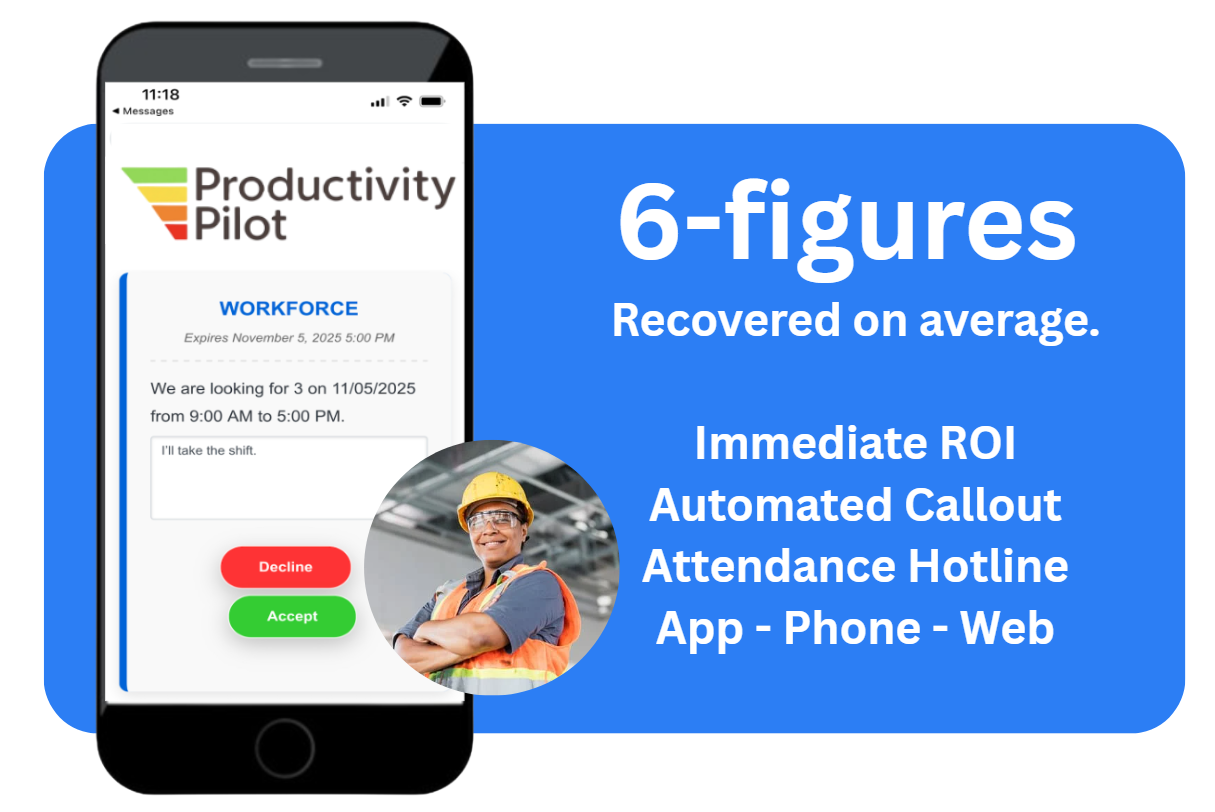
Productivity Pilot integrates absence reporting, attendance analytics, and scheduling automation into a single view so your team can:
- •Capture every call-off through a standardized, mobile-friendly flow.
- •Surface high-risk attendance patterns before they derail shifts.
- •Trigger coaching workflows and reminders when thresholds are met.
- •Rebalance schedules and reduce overtime for multi-line manufacturing facilities and multi-site logistics networks.
For healthcare, education, and public sector teams, the same engine helps leaders maintain safe staffing ratios and patient coverage and compliance while staying inside budget constraints.
FAQs: Employee absenteeism and difficult conversations
How should I handle absenteeism tied to chronic health issues?
Start with empathy and structure. Confirm your attendance data, then partner with HR to determine what information is appropriate to request and what accommodations may be reasonable. Your approach must align with applicable leave laws and disability regulations while still protecting staffing levels and service commitments.
What if absenteeism is tied to harassment or a toxic environment?
If an employee raises concerns about harassment, discrimination, or a hostile culture, the absenteeism conversation pauses and the investigation begins. Work with HR to document the concern, initiate your internal process, and provide interim support such as schedule changes or temporary reassignment while you address the underlying issue.
What legal risks should I be aware of when addressing absenteeism?
Legal risk typically arises when attendance policies are applied inconsistently, when protected leave is misclassified as misconduct, or when documentation is incomplete. Involve HR and legal when designing your policy, align your workflows with your privacy practices, and ensure attendance data used in decisions is accurate, auditable, and securely stored.
What if the employee doesn't agree their absences are excessive?
In that case, the documentation does the talking. Walk through the attendance record, show how you defined "excessive" upfront, and connect the pattern to operational impact—missed targets, forced overtime, or coverage gaps. Keep the conversation objective and focused on behaviors, not character.
How do I manage suspected abuse of sick leave?
Suspected abuse is a signal to tighten process, not to guess motives. Confirm that your policies explain when documentation is required, ensure call-off channels are consistent, and work with HR to decide if additional verification is appropriate. Avoid making assumptions based on rumor or frustration; let the data and policy guide your response.
Can high absenteeism signal deeper organizational issues?
Yes. Persistent absenteeism at a line, site, or department level often points to broader problems—scheduling practices that punish reliability, inconsistent supervision, burnout, or misaligned incentives. Use aggregated absence data from Productivity Pilot, combined with employee feedback, to distinguish individual patterns from systemic issues and build a targeted action plan.