How to Effectively Handle Employee No-Call No-Shows: The 2025 Framework
A practical guide for employers to reduce unplanned absences, protect operations, and maintain accountability—while balancing empathy with clear enforcement.
Picture this: It's Monday morning, the production line is staffed and ready. Suddenly you realize John from the assembly team is missing. No call. No text. No explanation. Just silence—and a scramble to cover his station before throughput takes a hit.
Sound familiar?
No-call no-shows aren't just inconveniences. They create cascading operational disruptions: missed production targets, overtime spikes, customer service strain, and team morale erosion. For businesses running tight schedules—manufacturing, healthcare, logistics, retail—these unplanned absences can materially impact daily performance.
This guide equips employers with frameworks, policies, and strategies to manage no-call no-shows effectively. When combined with strong employee call-in procedures and automated attendance tracking, businesses can significantly reduce these disruptive incidents. Whether you're running a 50-person operation or managing thousands across multiple sites, you'll find actionable approaches to reduce incidents, enforce accountability fairly, and build a more reliable attendance culture.
Disclaimer: The information in this guide is for general informational purposes only and does not constitute legal advice. Attendance policies and employment laws vary by state, country, and jurisdiction. We strongly recommend consulting qualified legal counsel before implementing or modifying no-call no-show policies in your workplace.
What Is a No-Call No-Show?
A no-call no-show occurs when an employee fails to report for their scheduled shift and does not notify their employer beforehand. Unlike approved time off or even last-minute call-ins, there's no communication—leaving supervisors unprepared and operations exposed. Organizations can reduce these incidents by implementing 24/7 answering services that make it easier for employees to report absences, and by training supervisors in proper phone etiquette when addressing attendance issues.
Why No-Call No-Shows Are Uniquely Disruptive
- •Zero advance notice: Unlike planned absences or sick calls, employers have no time to arrange coverage.
- •Operational ripple effects: Unplanned gaps trigger overtime, shift reassignments, production delays, or understaffed customer-facing teams.
- •Potential pattern behavior: While genuine emergencies happen, repeated no-call no-shows signal reliability issues.
- •Escalated consequences: Due to their disruptive nature, no-call no-shows typically carry more severe disciplinary action than other absences.
Understanding the behavior behind these incidents is the first step toward reducing them.
Why Employees No-Call No-Show: Root Causes & Psychology
To manage no-call no-shows effectively, you need to understand what drives them. While it's tempting to assume all incidents stem from irresponsibility, the reality is often more complex.
Common Reasons Behind Unexplained Absences
- •Genuine emergencies: Car accidents, sudden hospitalizations, or family crises can leave employees physically unable to communicate.
- •Mental health struggles: Depression, anxiety, or burnout can make work feel overwhelming, triggering avoidance behaviors.
- •Substance abuse issues: Addiction severely impacts decision-making and reliability.
- •Job dissatisfaction or disengagement: Employees disconnected from their work may express frustration through absence.
- •Policy confusion: Unclear attendance expectations leave employees unsure how or when to report absences.
- •Transportation failures: Unexpected vehicle breakdowns or public transit disruptions can strand employees without backup plans.
- •Oversleeping or schedule confusion: Common for early shifts or employees juggling multiple jobs.
- •Personal conflicts: Family crises or relationship issues may distract employees from following proper call-in procedures.
The Psychology of No-Call No-Show Behavior
- •Fear and anxiety: Some employees feel overwhelmed by the thought of explaining their absence, leading to avoidance. Fear of confrontation or consequences can paralyze communication.
- •Impulsivity: Spur-of-the-moment decisions to skip work—driven by immediate needs rather than long-term thinking—are common among younger or less experienced workers.
- •Disengagement: Employees who feel undervalued, disconnected, or dissatisfied are more likely to no-call no-show. Weak workplace relationships amplify this risk.
- •Learned helplessness: Repeated negative workplace experiences can lead to a "why bother" mindset, making it easier to justify not showing up or communicating.
- •Entitlement: Some employees prioritize personal needs over work responsibilities, treating attendance casually.
By recognizing these underlying factors, employers can design interventions that address root causes—not just symptoms—while still maintaining clear accountability standards.
Key takeaway: Understanding reasons doesn't excuse behavior. Use this knowledge to inform policies that support employees and enforce expectations consistently.
Acceptable vs. Unacceptable No-Call No-Show Excuses
Not all no-call no-shows are equal. Distinguishing valid reasons from unacceptable excuses ensures fair treatment while maintaining operational standards.
Valid Excuses (When Communication Was Genuinely Impossible)
- ✓Severe medical emergencies: Incapacitation, hospitalization, or acute illness preventing any form of communication.
- ✓Natural disasters or extreme weather: Conditions disrupting both attendance and communication infrastructure.
- ✓Critical family emergencies: Sudden, life-threatening situations involving immediate family requiring urgent attention.
- ✓Major accidents: Serious incidents (e.g., severe car crash en route to work) rendering the employee unable to communicate.
- ✓Verifiable widespread outages: Rare, provable large-scale technology or communication failures.
Unacceptable Excuses
- ✗Oversleeping: Including forgetting shifts or confusion about schedules.
- ✗Routine transportation issues: Common car troubles, traffic jams, or public transit delays.
- ✗Minor illnesses: Conditions that don't prevent basic communication (e.g., colds, headaches).
- ✗Social activities or hangovers: Prioritizing non-work events or recovering from personal activities.
- ✗Non-emergency personal matters: Routine appointments, minor family issues, or manageable personal situations.
Setting Clear Expectations
Even when an excuse falls into the "valid" category, employees should be expected to contact their employer as soon as reasonably possible—even if it's hours after their shift start.
Communicate these distinctions clearly in your attendance policy. Clarity reduces unjustified absences while ensuring supervisors apply standards fairly. However, remain flexible enough to evaluate individual circumstances—rigid policies can overlook genuine emergencies or unusual situations.
Balance is key: Be understanding of legitimate crises while enforcing policies consistently to maintain fairness and operational reliability.
No-Call No-Shows vs. Other Types of Absences
Understanding how no-call no-shows differ from other absence types helps clarify why they require stronger responses.
| Absence Type | Advance Notice | Approval Required | Operational Impact | Typical Consequence |
|---|---|---|---|---|
| Planned Time Off | Days/weeks | Yes | Minimal—coverage arranged | None (if approved) |
| Call-In (Sick/Personal) | Hours before shift | Sometimes | Moderate—last-minute coverage | Attendance point or documentation |
| No-Call No-Show | None | N/A | High—scramble for coverage | Written warning to termination |
| FMLA/Protected Leave | Varies | Yes | Planned coverage | None (legally protected) |
No-call no-shows carry the highest operational cost and typically trigger the most serious consequences.
How to Handle a No-Call No-Show: Step-by-Step Response
When an employee no-calls no-shows, a structured response protects operations, ensures fairness, and creates documentation for potential disputes.
Immediate Actions (Day of Incident)
1. Attempt contact (0-2 hours after shift start)
Call, text, and email the employee. Document each attempt with timestamps. Try emergency contacts if listed.
2. Secure coverage
Immediately assess staffing needs and deploy backup options: overtime for existing staff, float pool, or shift reassignment.
3. Document the incident
Record the employee's name, scheduled shift, time absence was discovered, contact attempts, and coverage actions taken. Use your attendance tracking system for audit-ready records.
Follow-Up Actions (Within 24-48 Hours)
4. Make contact with the employee
Once reached, request an explanation. Listen for valid reasons (emergencies) vs. unacceptable excuses.
5. Apply policy consistently
Reference your attendance policy and apply the appropriate consequence based on the employee's history and the reason provided.
6. Document the conversation
Record the explanation, any supporting documentation (e.g., medical notes), and the disciplinary action taken.
Ongoing Accountability
7. Monitor patterns
Track whether the employee has repeated no-call no-shows. Escalate consequences for repeat incidents.
8. Offer support if appropriate
If personal issues or health concerns contributed, connect the employee with Employee Assistance Programs (EAP) or accommodation resources.
Progressive Discipline for No-Call No-Shows
A structured escalation framework ensures consistency and fairness across your workforce.
Typical Progressive Discipline Model
- •First occurrence: Verbal warning with documentation; reiterate attendance policy and call-in procedures.
- •Second occurrence: Written warning placed in personnel file; review consequences of continued non-compliance.
- •Third occurrence: Final written warning or suspension (unpaid, if permitted by law and policy); notify employee that further incidents may result in termination.
- •Fourth occurrence: Termination of employment, subject to company policy and legal review.
Exceptions: Some companies terminate after one no-call no-show if during probationary period or if the employee abandons their position for multiple consecutive days.
Balancing Empathy and Accountability
- ✓Consider mitigating factors: Valid emergencies warrant leniency; chronic issues require escalation.
- ✓Maintain consistency: Apply disciplinary measures uniformly across all employees to avoid claims of favoritism or discrimination.
- ✓Offer support resources: Provide EAP, transportation assistance, or flexible scheduling options if personal difficulties are identified.
- ✓Communicate expectations clearly: Reiterate policies and the importance of communication after each incident.
- ✓Focus on improvement: Frame discipline as an opportunity to correct behavior, not purely as punishment.
- ✓Monitor progress: Follow up after disciplinary actions to acknowledge improvements or address ongoing issues.
- ✓Recognize good attendance: Positive reinforcement (attendance bonuses, recognition programs) encourages reliability.
By following a structured, fair approach, employers can manage no-call no-shows while preserving a supportive work environment and protecting against legal challenges.
Strategies to Reduce No-Call No-Shows
Prevention is far more effective than reaction. Here are proven strategies to minimize incidents:
Policy & Communication
- •Clear policy communication: Distribute attendance policies during onboarding; post them in break rooms and employee portals; review annually.
- •Simplified reporting systems: Implement 24/7 call-off hotlines, mobile portals, or IVR systems. Multiple channels accommodate diverse employee needs and eliminate "couldn't reach anyone" excuses.
- •Multilingual accessibility: For diverse workforces, offer absence reporting in up to 150 languages to eliminate communication barriers.
Work Environment & Culture
- •Flexible scheduling options: Offer shift swaps, self-scheduling, or varied shift lengths to accommodate personal needs.
- •Positive workplace culture: Address job satisfaction through engagement surveys, regular feedback, and work-life balance initiatives.
- •Attendance recognition programs: Reward consistent attendance with bonuses, extra PTO, or public recognition.
Management & Support
- •Supervisor training: Educate managers on spotting early warning signs of attendance issues and conducting constructive conversations.
- •Employee Assistance Programs (EAP): Offer confidential resources for mental health, substance abuse, childcare, or transportation challenges.
- •Health accommodations: Work with employees managing chronic conditions to develop flexible arrangements or intermittent FMLA plans.
Technology & Systems
- •Automated attendance systems: Deploy scheduling software with shift reminders sent via text/email to reduce forgotten shifts.
- •Predictable scheduling: Publish schedules weeks in advance; minimize last-minute changes to help employees plan childcare and transportation.
- •Real-time dashboards: Give supervisors immediate visibility into who's scheduled, who's called off, and who's missing—enabling faster coverage decisions.
Continuous Improvement
- •Regular policy reviews: Assess effectiveness quarterly; adjust based on data trends and employee feedback.
- •Onboarding enhancement: Set clear attendance expectations from day one; explain the "why" behind policies to build buy-in.
Tracking & Analyzing No-Call No-Show Data
Data-driven insights transform absence management from reactive firefighting to proactive workforce planning.
Key Metrics to Monitor
- •Frequency rate: No-call no-shows per employee over time (monthly/quarterly).
- •Departmental comparison: Identify teams or shifts with higher incident rates.
- •Day and time patterns: Pinpoint high-risk shifts (e.g., Monday mornings, weekend nights) for targeted interventions.
- •Reason analysis: When employees later provide explanations, categorize and track root causes.
- •Cost impact: Calculate overtime expense, productivity loss, and administrative time spent managing incidents.
- •Repeat offenders: Flag employees with multiple occurrences for escalated intervention.
Using Data to Inform Policy Adjustments
- •Policy effectiveness: Measure whether no-call no-show rates decrease after implementing new interventions (e.g., automated reminders, attendance bonuses).
- •Targeted interventions: Use shift or department-specific data to deploy focused solutions—e.g., transportation assistance for night-shift workers.
- •Training needs: High rates in specific teams may indicate supervisor coaching gaps or unclear policy communication.
- •Work environment factors: Correlate no-call no-show data with employee satisfaction surveys to identify disengagement risks.
- •Seasonal trends: Adjust staffing levels or policies during high-absence periods (e.g., holidays, flu season).
Consistent tracking and analysis enable organizations to shift from reactive discipline to proactive prevention.
Productivity Pilot Absence Management: Turning Call-Offs into Operational Intelligence
Productivity Pilot's absence management platform goes beyond basic call-off hotlines—it's a comprehensive system designed to streamline reporting, enforce accountability, and generate actionable workforce intelligence.
How Productivity Pilot Reduces No-Call No-Shows
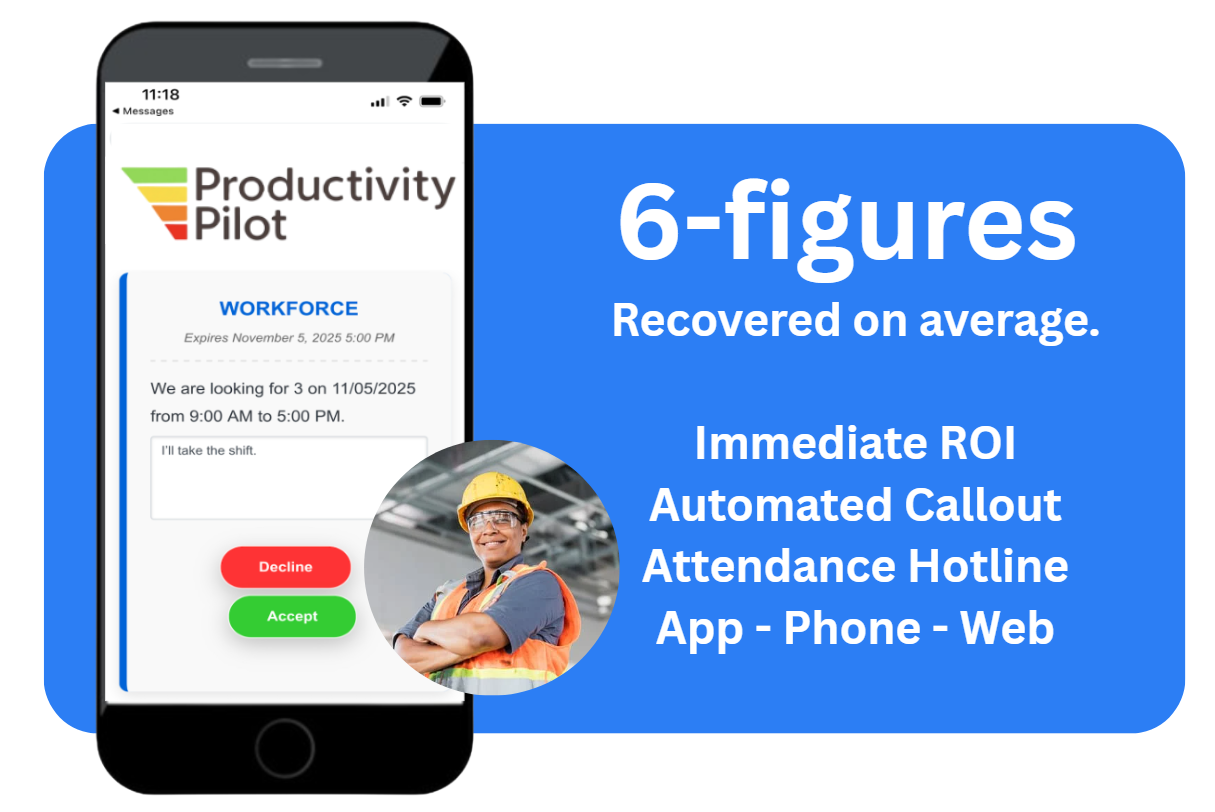
- •24/7/365 multi-channel reporting: Employees report absences via phone (live agent or IVR), text, or web portal—eliminating "couldn't reach anyone" excuses.
- •Multilingual coverage (up to 150 languages): Ensures equitable access for diverse workforces and eliminates communication barriers.
- •Automated data capture: Every absence report is time-stamped, reason-coded, and logged with audit-ready detail—no manual entry errors.
- •Real-time supervisor notifications: Instant alerts via email, SMS, or dashboard ensure supervisors can make coverage decisions immediately.
- •HRIS/WFM integrations: Seamless data flow to systems like Workday, UKG, ADP, PeopleSoft—eliminating swivel-chair work and ensuring payroll accuracy.
- •Attendance analytics dashboards: Visualize trends by department, shift, reason code, or employee—enabling data-driven policy adjustments.
- •Employee self-service portal: Empower employees to review their own attendance records, reducing administrative inquiries and promoting transparency.
- •Customizable escalation workflows: Trigger actions based on your policies—e.g., automatic HR alerts for repeat offenders or shift-fill requests for critical roles.
Business Impact
- •Faster coverage: Real-time alerts compress response time, minimizing production delays and overtime costs.
- •Higher accountability: Consistent, documented reporting processes reduce disputes and support progressive discipline.
- •Compliance-ready records: Time-stamped logs meet audit requirements and protect against grievances or legal challenges.
- •Forecasting insight: Reason-code analytics reveal patterns (e.g., transportation issues on night shifts) that inform proactive interventions.
- •Reduced admin burden: Automation eliminates manual call-off tracking, freeing HR and supervisors for strategic work.
Built for Scale
Whether you're managing 100 employees at a single site or 10,000 across multiple locations, Productivity Pilot scales to meet your needs—with enterprise-grade integrations, security (SOC 2 compliance), and multilingual support built in.
Key takeaway: No-call no-shows are a material drag on operations. Productivity Pilot turns absence management into an operating control that protects throughput, enforces accountability, and generates workforce intelligence.
Frequently Asked Questions
Can I terminate an employee after one no-call no-show?▼
It depends on your company policy and local employment laws. Some organizations terminate after a single occurrence, particularly during probationary periods or if the absence spans multiple consecutive days (job abandonment). However, most employers use progressive discipline to allow for genuine emergencies. Always consult legal counsel before implementing termination policies.
How do I distinguish between a no-call no-show and job abandonment?▼
Job abandonment typically involves multiple consecutive no-call no-shows (often 2-3 days) with no response to employer contact attempts. A single no-call no-show is usually treated as an attendance violation. Document all contact attempts and wait a reasonable period before assuming abandonment. Check your state's guidelines and company policy.
Should I accept a doctor's note retroactively for a no-call no-show?▼
A doctor's note may explain the absence reason but doesn't excuse the failure to communicate. The discipline addresses the lack of notification, not the absence itself. You can acknowledge the medical excuse while still enforcing consequences for not following call-in procedures (unless the employee was genuinely unable to communicate, such as being unconscious).
What if an employee claims they couldn't reach anyone to report their absence?▼
This highlights the importance of 24/7/365 reporting systems. Implement multiple channels: dedicated hotline, IVR system, text messaging, email, or web portal. Document that these options exist and train employees on them during onboarding. With modern systems, "couldn't reach anyone" becomes an invalid excuse.
How can I reduce no-call no-shows without being punitive?▼
Focus on prevention: simplify reporting processes, offer automated shift reminders, provide flexible scheduling options, and recognize good attendance. Address underlying causes like transportation challenges or childcare issues through EAP resources or targeted assistance programs. Balance accountability with support.
Are no-call no-shows more common in certain industries?▼
Yes. Industries with shift work, hourly employees, high turnover, or physically demanding jobs (manufacturing, healthcare, logistics, retail, hospitality) tend to see higher rates. Early morning shifts, weekend work, and night shifts also correlate with increased incidents. Use data analytics to identify your specific patterns.
What technology helps track no-call no-shows effectively?▼
Modern absence management platforms offer 24/7 multi-channel reporting, automated time-stamping, real-time supervisor alerts, HRIS integration, analytics dashboards, and audit trails. These systems eliminate manual tracking errors, provide instant visibility, and generate data for trend analysis and policy improvement.
Key Takeaways
- ✓No-call no-shows disrupt operations, inflate costs, and erode morale—they require structured management, not ad-hoc responses.
- ✓Understanding root causes (emergencies vs. disengagement) allows employers to balance empathy with accountability.
- ✓Clear policies and consistent enforcement reduce incidents and protect against legal challenges.
- ✓Prevention strategies—simplified reporting, flexible scheduling, positive culture—are more effective than reactive discipline.
- ✓Data-driven insights enable organizations to identify patterns, target interventions, and measure policy effectiveness.
- ✓Technology platforms like Productivity Pilot streamline reporting, automate notifications, and turn absence data into actionable intelligence.