
How to Improve Productivity in Healthcare with Smarter Workforce Strategy
Disciplined workforce management, smarter scheduling, and eliminating labor waste—without compromising patient care.
By Rich Titus
Evaluating operational improvements? See how healthcare systems are reducing unnecessary labor spend while stabilizing staffing levels.
Healthcare leaders today are operating in a margin-compressed environment. Government reimbursement pressure, labor shortages, and rising benefit costs mean productivity is no longer optional—it is operational survival. If you're asking how to improve productivity in healthcare, the answer starts with disciplined workforce management, smarter scheduling, and eliminating labor waste without compromising patient care.
At Productivity Pilot, we help healthcare organizations align staffing to real demand patterns, reduce premium labor dependency, and protect patient coverage and compliance across shifts and departments. This approach mirrors the same operational discipline that drives results in manufacturing productivity environments—applied to the unique demands of clinical and non-clinical healthcare operations.
The Real Cost of Inefficient Staffing
Most healthcare systems don't struggle with effort. They struggle with misalignment. Overtime creeps in. Agency labor fills gaps. On-call costs go unchecked. Education programs aren't synchronized with census fluctuations.
These inefficiencies compound quickly:
- Unplanned overtime driven by reactive scheduling
- Premium and agency labor filling gaps that float pools should cover
- Redundant nonclinical tasks consuming clinical hours
- Inflexible shift structures misaligned with demand patterns
- Underutilized float pools leading to unnecessary external spend
Over time, this erodes margins and increases burnout. Improving productivity in healthcare requires moving from reactive staffing to data-driven workforce planning. Organizations that have implemented structured scheduling solutions consistently see measurable reductions in premium labor dependency.
Reduce Overtime Without Sacrificing Coverage
Overtime is often treated as unavoidable. In reality, it's frequently a scheduling design issue. For a cross-industry framework on overtime elimination, see our complete guide on how to reduce overtime in 2026.
Healthcare systems can improve productivity by:
- •Identifying incidental versus scheduled overtime
- •Aligning staffing grids to census trends
- •Creating flexible core staffing models
- •Shifting schedulable work to slower periods
Key insight: When properly implemented, strategic scheduling can reduce overtime costs by up to 50% while maintaining patient coverage and compliance.
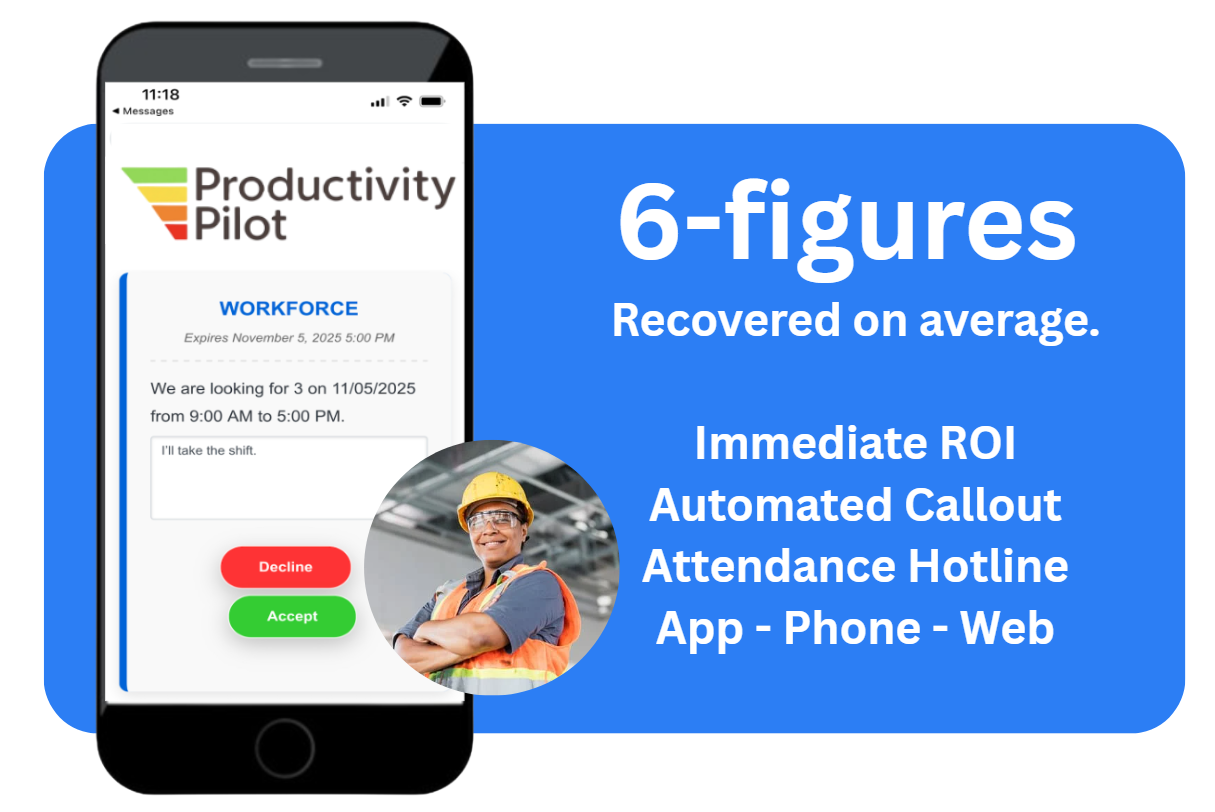
Our healthcare workforce management approach focuses on predictive scheduling, mobile call-off visibility, and real-time labor analytics that prevent unnecessary premium hours before they happen. Effective healthcare attendance tracking provides the data foundation that makes this possible.
Optimize Skill Mix and Labor Deployment
Another critical answer to how to improve productivity in healthcare is refining your skill mix.
Ask the hard questions:
- •Are highly paid clinicians performing administrative tasks?
- •Are support roles properly cross-trained?
- •Are float pools fully utilized before agency staff are engaged?
High-performing systems float staff across similar units, cross-train to reduce silo dependency, consolidate overlapping roles, and use per-diem and part-time blends strategically. This isn't about cutting staff. It's about maximizing the value of every hour worked.
Workforce and shift management tools make these decisions actionable by matching available staff to open shifts based on credentials, seniority, and availability in real time. For organizations managing complex leave scenarios alongside scheduling, our leave management guide provides a practical compliance framework.
Modernize Shift Structures and Flex Models
Rigid 12-hour blocks aren't always optimal. Healthcare demand fluctuates throughout the day.
Advanced organizations improve productivity by:
- •Flexing staff every four hours based on census data
- •Using nontraditional shifts to cover peak demand windows
- •Creating "sister units" for overflow placement
- •Scheduling education during slower census windows
Modern shift scheduling automation enables leadership teams to model these adjustments before implementation. Instead of guessing, you simulate coverage scenarios based on historical data—eliminating the trial-and-error approach that wastes labor hours.
Eliminate Non-Value-Added Work
Improving productivity in healthcare isn't only about staffing numbers—it's about workflow design.
Audit your environment for:
- •Duplicate documentation consuming clinical time
- •Manual call-off processes that delay coverage decisions
- •Paper-based absence tracking prone to errors
- •Delayed communication loops between departments
Digitizing absence reporting through employee call-in systems and automating policy enforcement reduces administrative overhead while improving data accuracy. When absences are captured in a structured format and routed automatically, supervisors spend less time chasing information and more time managing patient care.
Plan PTO and On-Call Strategically
Vacation and paid time off often trigger cascading overtime. Productivity-focused organizations:
- •Align PTO to historically slower census periods
- •Evaluate true on-call necessity by department
- •Analyze on-call usage patterns to identify waste
- •Develop flexible backup staffing pools
Instead of reacting to absences, predictive scheduling allows leaders to anticipate gaps before they create cost spikes. Organizations that have adopted structured absence management strategies report significantly lower unplanned overtime triggered by PTO cascades. Understanding FMLA compliance requirements is also critical to structuring PTO policies that hold up to legal scrutiny.
Build a Flexible Core Staffing Model
A strong productivity strategy includes:
Full-time anchors
Core coverage baseline across departments
Part-time flexibility
Scheduled elasticity without overtime triggers
Per-diem surge capacity
On-demand coverage without agency premiums
Cross-trained float pools
Multi-unit deployment based on credentials
This hybrid structure gives healthcare systems elasticity without overreliance on agency labor. Mass communication tools enable rapid outreach to per-diem and float pool staff when coverage gaps emerge, ensuring the right people are reached through the right channel in real time.
Productivity Is a System, Not a Single Tactic
If you're serious about improving productivity in healthcare, it requires:
- •Visibility into real labor trends
- •Automation in absence and scheduling workflows
- •Policy consistency across departments
- •Predictive modeling for coverage
- •Ongoing performance monitoring
This is where operational rigor meets workforce technology. Healthcare leaders who adopt structured scheduling automation and attendance point tracking consistently report measurable labor cost reductions, improved staff satisfaction, and stabilized coverage. The same operational principles apply to managing employee attendance across any shift-dependent industry.
Ready to Improve Healthcare Productivity?
Improving productivity in healthcare doesn't require compromising care quality. It requires eliminating waste, optimizing staffing structures, and deploying workforce management tools designed for complex environments.
Operational discipline drives margin stability. Smarter staffing protects both patients and performance.
Want to explore related workforce strategies? See how HR teams directly improve the bottom line, or learn how structured attendance management software reduces risk across healthcare operations.
Frequently Asked Questions
Editorial standards: This article is based on operational best practices observed across healthcare organizations using workforce management platforms. Recommendations are intended for informational purposes.