
How to Reduce Employee Turnover in Manufacturing
A Practical Playbook for Sustainable Retention in 2026
By Rich Titus
Ready to stabilize your workforce? See how manufacturing leaders reduce absenteeism by up to 50% and lower turnover with Productivity Pilot.
Quick Summary for Operations Leaders
Manufacturing turnover remains one of the most expensive operational risks in 2026. If you want to reduce employee turnover in manufacturing, focus on five controllable drivers:
High-performing plants treat retention as an operational metric, not an HR afterthought. With the right workforce management for manufacturing, you can reduce absenteeism by up to 50%, stabilize schedules, and improve frontline trust. The result: fewer resignations, lower overtime, and a more predictable production floor.
Employee Turnover in Manufacturing: Why It's Still a Crisis
Manufacturing continues to face turnover rates significantly higher than national averages. Replacing a single frontline worker can cost thousands in recruiting, onboarding, training, and lost productivity. But the true cost isn't just financial. It's operational.
The Hidden Impact of Turnover
- •Production lines slow down during training ramp-up
- •Overtime spikes as remaining staff absorb the load
- •Supervisors burn out managing constant churn
- •Culture erodes as institutional knowledge walks out
Most turnover is not random. It is systemic. When employees leave, they're often responding to patterns they've experienced for months. If you want to reduce employee turnover in manufacturing, you must treat retention as a production strategy. The same operational discipline that drives manufacturing productivity improvements also drives retention.
Want to see how manufacturing leaders are stabilizing their workforce? Get a personalized walkthrough of Productivity Pilot's absence and scheduling automation.
How to Calculate Employee Turnover
Start with a simple formula:
Turnover Rate = (Employees Who Left ÷ Average Number of Employees) × 100
This gives you a baseline. But numbers alone won't fix the problem. Ask deeper questions:
- •Are departures concentrated on specific shifts?
- •Are newer hires leaving within 90 days?
- •Is absenteeism increasing before resignations?
Turnover is often preceded by attendance instability. Companies that implement structured manufacturing attendance tracking and communication systems see measurable improvements in retention. For a deeper look at absence metrics, see our guide on how to calculate absenteeism.
What Is a Healthy Turnover Rate in Manufacturing?
Some turnover is necessary. Poor culture fits and underperformance should not be retained. However, most manufacturing organizations should aim for 10% or less annually for stable operations.
When turnover climbs above that threshold, you begin to see:
- Escalating overtime costs
- Increased safety incidents
- Supervisor fatigue
- Lower morale
Retention stability directly impacts profitability. Organizations that adopt structured attendance management as a core operational discipline consistently outperform those that treat it reactively.
Root Causes of Manufacturing Turnover
1. Attendance Friction and Policy Confusion
When attendance policies are unclear, inconsistent, or manually enforced, employees lose trust. Frontline workers want transparency. They want to know how call-offs are tracked, how points accumulate, and what triggers disciplinary action.
Modern attendance point tracking tools eliminate ambiguity. A structured, automated system reduces conflict and creates fairness across shifts. Clear systems build trust. Trust reduces turnover. For a complete framework, explore our guide on attendance point systems.
2. Overtime and Burnout
Chronic overtime is one of the strongest predictors of resignation. When staffing gaps aren't addressed early, your most reliable workers absorb the burden. That leads to fatigue, resentment, and eventually departure.
Smart scheduling automation prevents this spiral by forecasting coverage gaps before they impact production. Plants using predictive scheduling reduce overtime volatility and improve retention simultaneously. See how shift scheduling for large workforces works as a capacity control function, and explore our complete guide on how to reduce overtime.
3. Lack of Growth Path Visibility
Frontline workers stay where they see upward mobility. If operators cannot identify a path to lead, technician, or supervisory roles, they'll find it elsewhere.
Retention improves when skill progression is mapped, certifications are supported, and training programs are visible and structured. Growth clarity reduces flight risk.
4. Weak Communication Between Frontline and Leadership
Manufacturing environments move fast. Communication often lags. If employees only hear from leadership when something goes wrong, engagement drops.
Plants that implement structured communication systems—including automated attendance notifications and real-time reporting—improve supervisor responsiveness and frontline satisfaction. Communication isn't soft. It's operational.
Stop the Turnover Cycle
Most manufacturing turnover is preventable. See how Productivity Pilot helps plants reduce absenteeism by up to 50%, stabilize schedules, and improve frontline trust.
Short-Term Strategies to Reduce Employee Turnover in Manufacturing
You can begin stabilizing retention immediately by focusing on controllable actions.
Improve Onboarding Execution
New hires who feel lost in the first 30 days are more likely to leave within 90.
- Standardize training sequences
- Pair new employees with experienced mentors
- Provide clear attendance expectations from day one
Stabilize Attendance Processes
Manual call-offs create chaos. An automated attendance workflow captures absence data in real time, alerts supervisors immediately, reduces no-call no-show incidents, and syncs with payroll and HR systems. This removes stress from supervisors and builds credibility with frontline teams.
For structured guidance on policy development, see our guide on how to develop a call-out policy.
Address Overtime Before It Escalates
Overtime should be strategic, not reactive. Using integrated scheduling automation tools within your broader workforce management system gives visibility into labor gaps before they create burnout. Balanced scheduling is one of the fastest ways to improve morale.
Long-Term Retention Strategy for Manufacturing Leaders
Reducing employee turnover in manufacturing requires systemic investment.
1. Modernize Workforce Infrastructure
Outdated systems create friction. Forward-thinking plants invest in automated attendance tracking, real-time labor visibility, policy compliance reporting, and production-aligned scheduling tools.
Companies that adopt digital workforce management for manufacturing improve retention, reduce absenteeism, and protect margin stability. Learn how improving manufacturing efficiency and retention go hand in hand.
2. Build a Culture of Fairness and Accountability
Retention improves when policies are applied consistently. A structured point-based attendance model, supported by automated tracking, ensures fairness across shifts.
Transparency removes politics. Consistency builds confidence. Organizations managing progressive discipline through automated systems see significantly fewer grievances and policy disputes.
3. Invest in Technology That Reduces Supervisor Burden
Supervisors are often the silent casualty of turnover. When managers spend hours chasing call-offs, filling gaps, and reconciling spreadsheets, engagement suffers at every level. Automated attendance management systems free leadership to focus on coaching, development, and engagement—not crisis management.
The Operational Impact of Getting This Right
When manufacturers stabilize attendance and scheduling systems, the results compound:
Turnover reduction is not a morale initiative. It is a margin initiative. Learn how HR directly impacts the bottom line when workforce systems are optimized.
How Productivity Pilot Helps Reduce Employee Turnover
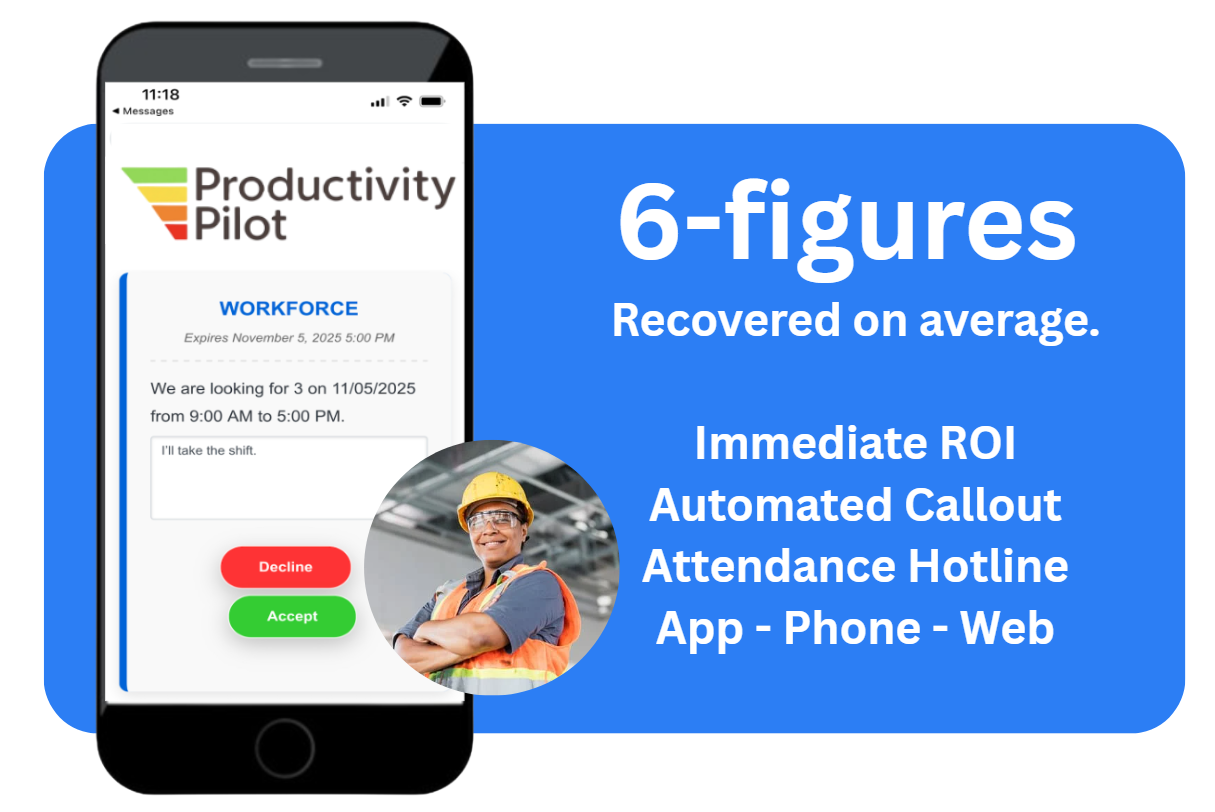
Productivity Pilot delivers app-free, frontline-friendly attendance and scheduling automation built for industrial environments.
By creating transparent call-off processes, real-time supervisor alerts, and automated reporting, you reduce friction at the root level. Retention improves when operations become predictable.
Reduction in absenteeism
Languages supported
Supervisor notifications
Ready to Reduce Manufacturing Turnover?
If you're ready to reduce employee turnover in manufacturing and stabilize your labor force, it's time to modernize your workforce infrastructure. Operational discipline drives margin stability. Smarter staffing protects both production and people.
Explore related resources: 5 ways to manage employee absences | reduce no-call no-shows
Frequently Asked Questions
Editorial standards: This article is based on operational best practices observed across manufacturing organizations using workforce management platforms. Recommendations are intended for informational purposes.