How to Improve Manufacturing Productivity Without Increasing Headcount
Manufacturing productivity is rarely limited by machines alone. In most plants, performance loss is driven by unpredictable labor availability, reactive scheduling decisions, and manual processes that break under pressure. When attendance gaps go unmanaged, productivity erodes long before output targets are missed.
Stabilize throughput without adding headcount
Productivity Pilot helps manufacturing leaders anticipate labor risk, automate scheduling decisions, and reduce absenteeism-related disruptions by up to 50%. See how workforce management for manufacturing can stabilize your operations.
Why Traditional Productivity Improvements Stall
Lean initiatives, automation investments, and continuous improvement programs all assume one constant: the right people show up, on time, and fully staffed. When that assumption fails, even the best-designed systems underperform.
- •Manual attendance tracking delays corrective action
- •Spreadsheets cannot predict labor risk across shifts
- •Supervisors lack real-time visibility into coverage gaps
- •Overtime becomes the default solution instead of the exception
Productivity Starts With Attendance Intelligence
High-performing manufacturers treat attendance as an operational variable, not an HR afterthought. Productivity improves when leaders can anticipate labor risk before it impacts production schedules.
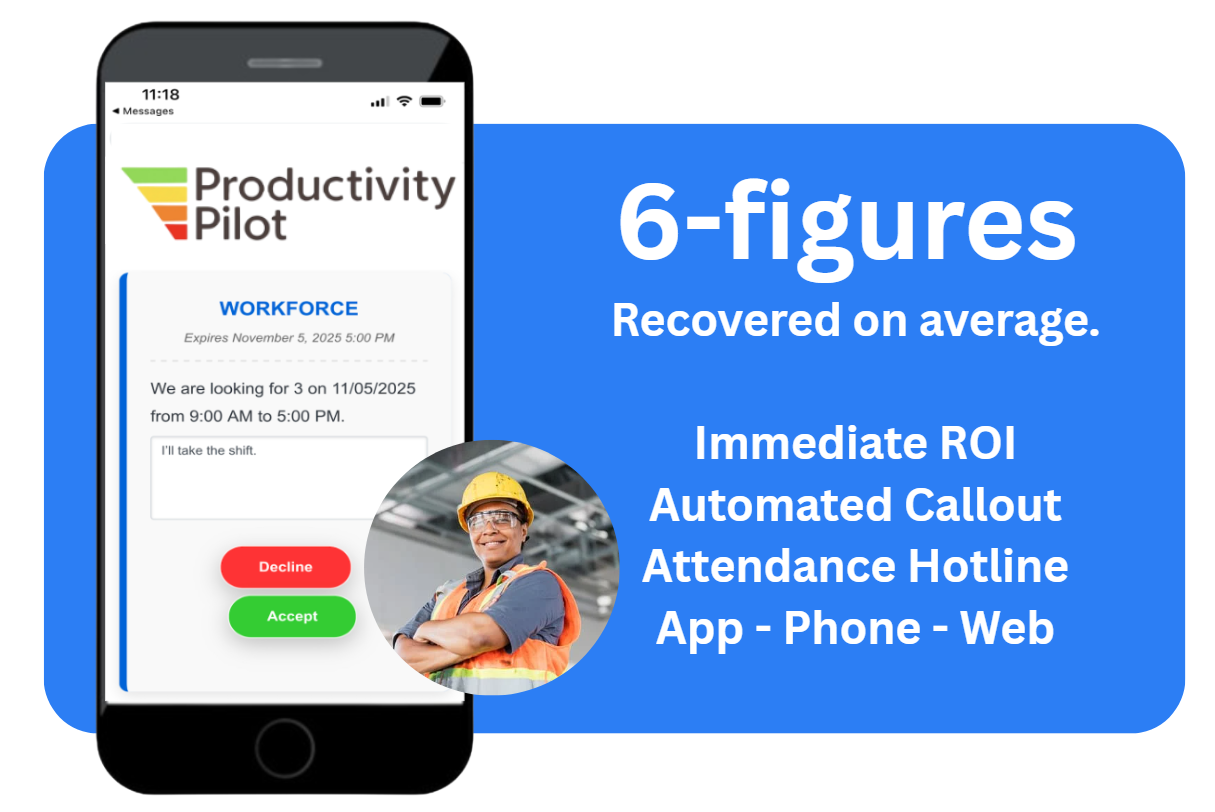
Workforce intelligence platforms like Productivity Pilot surface attendance patterns early, identify at-risk shifts, and enforce policy-driven responses automatically. This allows operations teams to intervene before output is compromised. Learn more about how multi-channel attendance tracking provides real-time visibility across all shifts and locations.
How Scheduling Automation Drives Measurable Gains
Smart scheduling automation replaces reactive firefighting with proactive control. Instead of waiting for a call-off, managers can see risk signals days in advance and rebalance labor accordingly.
- •Predictive absenteeism modeling flags coverage gaps early
- •Automated escalation enforces attendance policy consistently
- •Real-time dashboards give supervisors actionable visibility
- •Overtime usage is reduced by addressing root causes
Plants using automated attendance enforcement routinely achieve up to 50% reductions in absenteeism-related disruptions, while stabilizing throughput and lowering labor cost volatility. See how policy automation can transform your operations.
Aligning Labor Strategy With Production Reality
Manufacturing productivity improves fastest when labor planning aligns with actual production constraints. That requires systems that integrate attendance behavior, shift demand, and policy compliance into a single operational view.
Productivity Pilot enables operations leaders to move beyond gut decisions and manual tracking, replacing them with structured workflows that scale across plants, lines, and shifts. Explore how automated point tracking ensures consistent policy enforcement across your entire workforce.
From Reactive Management to Predictable Performance
Improving manufacturing productivity does not require more people or longer hours. It requires eliminating the variability that silently undermines execution every day.
When attendance risk is visible, scheduling decisions are automated, and policies are enforced consistently, productivity becomes predictable. Output stabilizes. Costs normalize. Supervisors regain control of the floor. The downstream effect is equally powerful: plants that stabilize operations this way also see significant improvements in employee retention.
See How Workforce Automation Impacts Your Plant
If absenteeism, overtime creep, or last-minute staffing gaps are limiting your productivity, it is time to address the root cause.
Schedule a 20-minute demo to see how Productivity Pilot helps manufacturers improve productivity by stabilizing attendance, automating scheduling decisions, and enforcing policy at scale.