
Clinical Workforce Management
Improving Coverage, Reducing Operational Risk, and Strengthening Patient Care
Hospitals, health systems, and long-term care organizations face mounting pressure to maintain staffing coverage while controlling labor costs — here is how modern workforce management changes the equation
By Rich Titus
See how healthcare organizations are improving staffing visibility and reducing workforce disruptions with modern workforce management technology.
Quick Summary
Clinical workforce management has become one of the most important operational priorities in healthcare. Hospitals, health systems, clinics, rehabilitation centers, and long-term care organizations are under constant pressure to maintain staffing coverage, reduce burnout, control labor costs, and remain compliant with evolving workforce regulations — all simultaneously.
What Is Clinical Workforce Management?
Clinical workforce management refers to the systems, policies, processes, and technology used to manage healthcare staffing operations efficiently. It includes scheduling, attendance management, overtime monitoring, leave management, staffing coverage optimization, communication workflows, and workforce compliance tracking.
Unlike traditional scheduling systems that focus only on assigning shifts, modern clinical workforce management platforms provide healthcare organizations with operational visibility into workforce behaviors, staffing gaps, and labor trends in real time — enabling intervention before problems reach patients.
Healthcare organizations use workforce management systems to:
Why Clinical Workforce Management Matters in Healthcare
Healthcare staffing challenges have intensified significantly in recent years. Rising labor costs, workforce shortages, increased patient volumes, and operational burnout are forcing healthcare leaders to rethink how workforce operations are managed. Many healthcare organizations still rely on disconnected systems, spreadsheets, manual call-off procedures, or outdated attendance processes that create operational inefficiencies across clinical teams.
Last-minute employee call-offs
Unplanned absences trigger cascading coverage gaps that fall on already stretched clinical staff — accelerating burnout and increasing overtime dependency.
Chronic overtime dependency
Without centralized workforce visibility, managers repeatedly turn to overtime as the default gap-fill — driving labor costs well above budget targets.
Scheduling inefficiencies
Manual scheduling processes create conflicts, errors, and coverage blind spots that reduce staffing reliability and increase administrative workload.
Compliance documentation gaps
Attendance, leave, and overtime records maintained in disconnected systems create compliance exposure during audits and regulatory reviews.
Even relatively small disruptions in staffing coverage can create cascading operational problems throughout a healthcare system. One unexpected absence may trigger overtime exposure, patient care delays, workflow interruptions, or increased burnout for other clinical employees covering shifts. Clinical workforce management creates more predictable staffing operations while reducing operational volatility.
Key Components of Effective Clinical Workforce Management
A comprehensive clinical workforce management strategy addresses four interconnected operational areas. Each reinforces the others — improving one consistently improves performance across all four.
Attendance and Absence Management
Employee absences remain one of the largest hidden operational costs in healthcare. Without structured absence tracking systems, healthcare organizations often struggle to identify attendance trends, manage call-offs consistently, and maintain appropriate staffing levels. Modern workforce management systems centralize absence reporting workflows and improve visibility into attendance patterns — allowing healthcare leaders to respond faster to staffing disruptions while creating stronger workforce accountability.
Centralized absence reporting
All call-offs, late arrivals, and absence requests flow through one system — eliminating text chains and manual tracking that create visibility gaps.
Attendance trend visibility
Patterns across employees, departments, and shifts surface automatically — enabling early intervention before chronic absence becomes a staffing crisis.
Consistent policy application
Absence management rules apply uniformly across all clinical staff, removing manager subjectivity that creates compliance risk and employee grievances.
Data-driven accountability
Attendance records are maintained automatically and accessible for performance conversations, disciplinary processes, and compliance documentation.
For a deeper look at building an effective absence management strategy, see our guide on absence management systems for 2026 and how to improve employee attendance across shift-based workforces.
Scheduling Automation
Manual scheduling processes consume significant administrative time and often increase scheduling errors that create coverage gaps, compliance risk, and employee dissatisfaction. Clinical scheduling automation optimizes portions of the scheduling process to improve staffing efficiency and reduce the administrative burden on charge nurses, schedulers, and operations staff.
Overtime Management
Healthcare overtime costs can escalate quickly when staffing visibility is limited. Organizations frequently experience excessive overtime because managers lack centralized workforce insights across departments or facilities — they cannot see who is approaching overtime thresholds until the cost has already been incurred.
Early risk identification
Workforce management systems flag overtime risks before shifts are approved — not after payroll closes and costs are locked in.
Balanced labor distribution
Visibility across the entire workforce allows schedulers to distribute hours more equitably, reducing reliance on the same small group of staff.
Proactive cost control
Organizations gain the ability to manage overtime as a deliberate decision rather than an unavoidable operational default.
Facility-wide visibility
For multi-site health systems, centralized oversight eliminates the department-level blind spots that drive system-wide overtime spending.
For a comprehensive framework on controlling overtime across shift-based operations, see our guide on how to manage overtime in the workplace — many of the same principles apply directly to clinical staffing environments.
Communication Workflows
Healthcare staffing environments move quickly, and communication delays can create serious operational consequences. Workforce management systems streamline employee communication through centralized notification systems, absence reporting tools, and staffing alerts — replacing fragmented text chains and phone trees that slow response times and create documentation gaps.
Instant absence notifications
When an employee calls off, the right people are notified immediately — not after a chain of manual calls delays the response.
Automated coverage requests
Available staff are contacted through preferred channels (SMS, email, app, voice) the moment a gap is identified — reducing the time to fill.
Communication audit trails
Every notification, response, and staffing decision is documented automatically — supporting both compliance and accountability.
Cross-department coordination
Staffing alerts and shift updates reach the right teams across departments without manual coordination between charge nurses and operations.
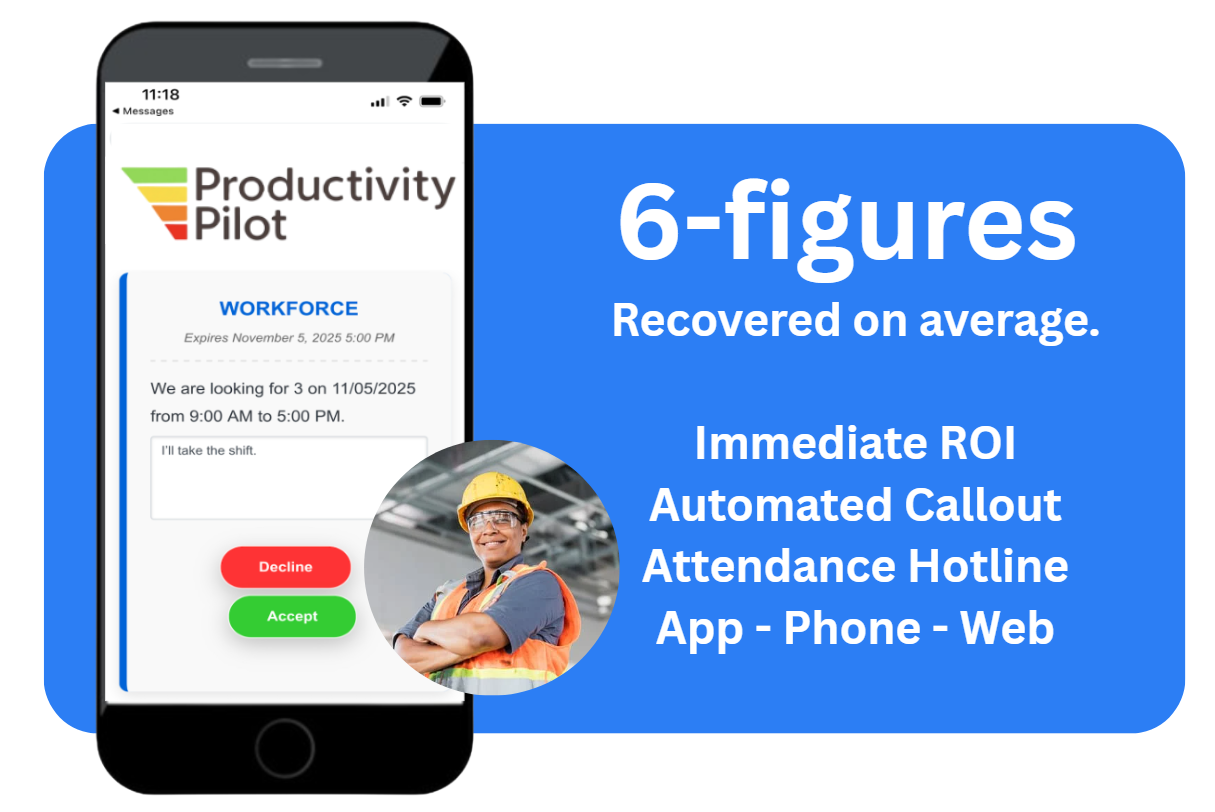
Productivity Pilot's mass communication platform reaches clinical staff across SMS, email, app, and voice in 150+ languages — ensuring no employee is missed during a coverage response regardless of shift, location, or language preference.
How Clinical Workforce Management Improves Patient Care
Clinical workforce management is not only about labor efficiency — it directly impacts patient care continuity and operational reliability. When staffing operations become unstable, patient experience suffers. Delayed care, overworked employees, communication breakdowns, and coverage gaps all contribute to reduced patient satisfaction and increased operational risk.
Safer staffing levels
Consistent coverage ensures patient-to-staff ratios stay within safe ranges — reducing the clinical risk that comes with short-staffed shifts.
Reduced staff fatigue and burnout
When overtime is managed proactively and scheduling is equitable, clinical employees work sustainable hours — improving both performance and retention.
Faster patient response times
Better-staffed teams respond to patient needs more quickly — improving care quality metrics and patient satisfaction scores.
Stronger workforce continuity
Reduced turnover driven by better working conditions means patients receive care from familiar, experienced clinical staff rather than frequent rotating replacements.
Healthcare systems that invest in workforce infrastructure increasingly view workforce management as a patient care strategy — not simply an HR or operations function. This is the core argument behind the healthcare workforce management approach: that staffing visibility and operational reliability are patient safety investments.
Compliance and Workforce Accountability in Healthcare
Healthcare organizations operate within highly regulated environments where workforce compliance failures create operational, legal, and financial exposure. Clinical workforce management systems help organizations improve documentation consistency, policy enforcement, attendance tracking, and labor reporting workflows — reducing compliance risk without increasing administrative burden.
For organizations navigating the specific compliance requirements around FMLA and attendance policy, see our guide on FMLA attendance policy compliance. Healthcare organizations evaluating workforce technology solutions can also review implementation and support FAQs to understand deployment timelines and integration processes before beginning a modernization initiative.
Clinical Workforce Management Metrics That Matter
Healthcare leaders increasingly rely on workforce analytics to make staffing decisions based on operational data rather than assumptions. The following metrics provide the visibility needed to identify problems early and allocate labor efficiently. See our broader guide on HR reporting and analytics in 2026 for the framework that makes these metrics actionable.
Absenteeism rates by department
Identifies where attendance problems are concentrated so intervention can be targeted rather than system-wide.
Overtime percentages
Tracks premium labor spend as a share of total cost — the primary signal that scheduling or policy enforcement has a gap.
Shift fulfillment rates
Measures how reliably open shifts are filled before they become coverage emergencies requiring overtime.
Time-to-fill open shifts
Shorter fill times reduce overtime dependency and indicate a healthy bench of available, responsive staff.
Employee turnover trends
Persistent turnover in specific departments often signals scheduling inequity, burnout risk, or management consistency issues.
Schedule adherence rates
Tracks whether clinical staff work their assigned shifts — a leading indicator of disengagement and attendance risk.
Healthcare organizations that monitor workforce metrics consistently are better equipped to reduce unnecessary labor costs, identify operational inefficiencies, and improve staffing performance over time. Some organizations implementing workforce management modernization have reported up to 50% reductions in absenteeism-related disruptions when communication workflows, attendance visibility, and staffing response processes are improved together.
The Future of Clinical Workforce Management
Healthcare workforce management is evolving rapidly as organizations seek greater operational resilience and staffing flexibility. Modern workforce management initiatives increasingly include capabilities that were unavailable or cost-prohibitive just a few years ago.
Real-time workforce analytics
Dashboard visibility into attendance, coverage, and labor spend as it happens — not in weekly reports reviewed after the damage is done.
Mobile workforce communication tools
Clinical staff receive and respond to scheduling changes, coverage requests, and policy updates from any device, in any language.
Automated attendance workflows
Call-off reporting, absence tracking, and policy triggering happen automatically — reducing the administrative load on charge nurses and HR.
Predictive staffing insights
Systems identify upcoming coverage risks based on historical patterns, allowing proactive staffing decisions before gaps appear on the schedule.
Cross-facility staffing coordination
Multi-site health systems gain the ability to balance workforce resources across locations — reducing overtime in one facility by leveraging availability in another.
Healthcare organizations that modernize workforce operations earlier are better positioned to adapt to labor market volatility, staffing shortages, and increasing patient demand. Organizations outside healthcare are seeing similar operational benefits — particularly in manufacturing workforce management, where operational continuity and staffing efficiency also play a major role in performance outcomes.
Frequently Asked Questions About Clinical Workforce Management
Build a More Stable Clinical Workforce Operation
Healthcare staffing challenges are unlikely to slow down in the coming years. Organizations that improve workforce visibility, streamline staffing coordination, and modernize communication workflows are better positioned to reduce operational risk while improving workforce continuity — and ultimately, patient care.
If your organization is evaluating workforce modernization initiatives, explore how structured clinical workforce management can improve staffing reliability, reduce overtime dependency, and create the operational foundation that healthcare teams need to perform at their best.
Ready to Modernize Your Clinical Workforce Operations?
Productivity Pilot helps healthcare organizations centralize attendance tracking, automate scheduling workflows, enforce policies consistently, and communicate with frontline clinical staff at scale — all in one platform.
Related reading: absence management systems | managing overtime | HR reporting and analytics
Editorial standards: This article is based on workforce management best practices observed across healthcare organizations. It is intended for informational purposes and does not constitute legal, clinical, or regulatory advice.