What Is Absence Management Software? The Complete Guide for Modern Workforce Operations
Absenteeism quietly drains productivity, increases overtime, disrupts scheduling, and creates operational instability. Here's how modern platforms put organizations back in control.
By Rich Titus
Quick Summary
Organizations implementing structured absence management programs typically report measurable operational improvements across these key areas:
Up to 50%
Reduction in unplanned absenteeism
10–20%
Decrease in overtime costs
Significant
Reduction in HR administrative workload
Most companies start by managing attendance manually — spreadsheets, HR emails, voicemail systems, and disconnected payroll. Eventually that approach breaks down under the weight of unplanned absences, scheduling gaps, and compliance complexity.
Modern absence management platforms consolidate attendance tracking, leave requests, scheduling visibility, compliance monitoring, and workforce reporting into one operational system. The result is fewer disruptions, lower labor costs, and stronger workforce accountability across every shift.
What Is Absence Management Software?
Absence management software is a workforce management system designed to track, monitor, automate, and optimize employee attendance, leave requests, call-offs, schedule disruptions, and compliance-related workforce events.
Instead of relying on disconnected tools, organizations gain a single platform for attendance tracking, leave management, sick time monitoring, FMLA administration, shift coverage coordination, overtime prevention, employee notifications, policy enforcement, and workforce reporting. For operations leaders, it becomes the command center for workforce reliability.
Traditional Processes vs Modern Absence Management
| Traditional Processes | Modern Absence Management Software |
|---|---|
| Paper attendance logs | Real-time digital attendance tracking |
| Call-off voicemail systems | Automated absence reporting |
| Spreadsheet leave tracking | Centralized leave management |
| Reactive staffing adjustments | Predictive workforce planning |
| Manual overtime monitoring | Automated labor alerts |
| HR-driven attendance reviews | Real-time manager dashboards |
| Delayed payroll reconciliation | Integrated payroll synchronization |
Why Absenteeism Becomes So Expensive
Many organizations underestimate the true financial impact of absenteeism because the costs extend far beyond the absent employee. Operational consequences include overtime escalation, production delays, customer service breakdowns, schedule instability, increased manager workload, compliance exposure, and burnout among reliable employees.
For industries operating on tight labor margins — manufacturing, logistics, healthcare, hospitality, warehousing, retail, and distribution — even small attendance disruptions compound quickly. Organizations focused on workforce management for manufacturing or teams managing delivery schedules often feel the impact immediately because staffing disruptions directly reduce operational throughput.
The Hidden Cost of One Unplanned Absence
| Cost Driver | Operational Impact |
|---|---|
| Overtime replacement | Increased labor spend |
| Productivity disruption | Lower output and throughput |
| Supervisor intervention | Lost management time |
| Payroll adjustments | Administrative burden |
| Compliance risks | Potential legal exposure |
| Shift coverage delays | Customer experience decline |
| Employee burnout | Increased turnover risk |
Core Features to Look For in Absence Management Software
Not all absence management systems are built equally. Some focus only on leave tracking. Others provide enterprise-grade workforce intelligence and operational automation. Here are the features that matter most.
Attendance Tracking
Modern systems provide real-time visibility into clock-ins, clock-outs, tardiness patterns, missed punches, no-call/no-shows, and attendance trends. This creates accountability while helping managers identify workforce risks before they escalate. Platforms like Productivity Pilot also support multi-channel attendance tracking via phone, text, app, and web across 150+ languages.
Automated Call-Off Management
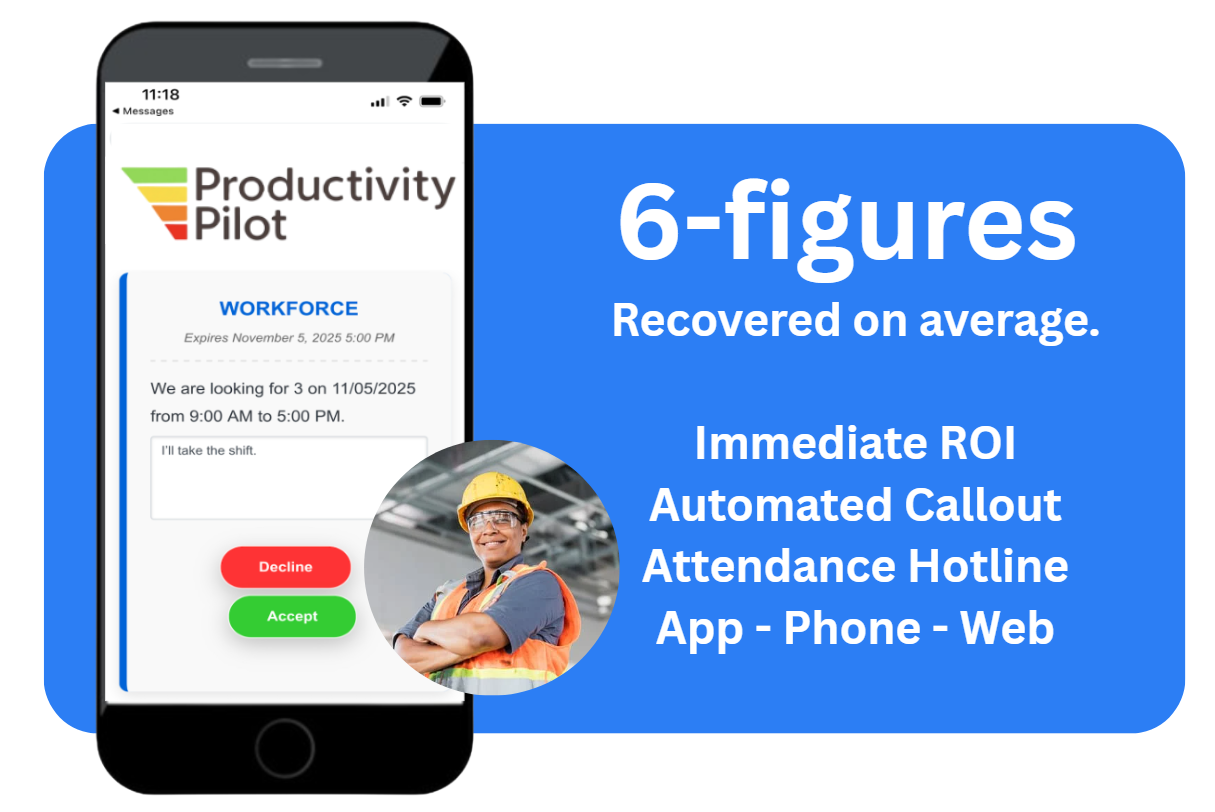
One of the largest operational bottlenecks is handling employee call-offs manually. Modern platforms automate absence reporting, supervisor notifications, shift replacement workflows, attendance documentation, and escalation procedures — significantly reducing manager workload during labor shortages.
Leave Management
Strong absence management platforms centralize PTO tracking, sick leave, vacation approvals, FMLA management, medical leave documentation, and state-specific leave compliance. This improves consistency and reduces compliance exposure across every department.
Real-Time Workforce Visibility
Operations leaders need instant access to workforce conditions. Modern dashboards surface active absences, overtime risk, attendance trends, shift coverage gaps, department-level absenteeism, and labor utilization — enabling immediate, informed decisions rather than reactive scrambling.
Compliance Monitoring
Attendance policies alone do not ensure legal compliance. Absence management software helps organizations manage FMLA compliance, state sick leave laws, attendance documentation, union requirements, overtime thresholds, and labor audit trails. Healthcare organizations in particular rely heavily on automated compliance monitoring because staffing gaps can directly affect patient safety and regulatory exposure.
What Strong Platforms Include
- Attendance point system tracking with FMLA/ADA protection
- Mass communication across SMS, email, app, and voice in 150+ languages
- HRIS integration with 150+ platforms for real-time data sync
- Automated progressive discipline documentation
- Workforce capacity planning and early warning staffing alerts
- Manager dashboards with shift-level visibility
How AI Is Changing Absence Management
AI is fundamentally reshaping workforce operations. Instead of simply recording attendance issues, modern systems now predict workforce disruptions before they occur — allowing organizations to move from reactive firefighting to proactive planning.
AI-powered absence management enables three new capabilities:
Attendance Forecasting
- High-risk absenteeism periods
- Repeat attendance behaviors
- Seasonal staffing trends
- Department burnout indicators
- Shift-level no-show probability
Scheduling Optimization
- Historical attendance data
- Shift preferences and skills
- Labor demand patterns
- Compliance thresholds
- Overtime exposure
Automated Alerts
- Overtime risk increases
- Coverage gaps emerging
- Attendance violations
- Labor costs exceeding targets
- Unsafe staffing levels
The result is a workforce management system that surfaces problems early enough for managers to act — rather than discovering gaps only after a shift starts short-staffed.
The Difference Between Absence Management Software and HR Software
Many businesses mistakenly assume HR software handles absence management effectively. In reality, the two systems serve very different operational purposes. HR software focuses on employee administration and long-term workforce strategy. Absence management software focuses on day-to-day attendance, scheduling, and operational workforce execution. Most organizations eventually require both.
| Absence Management Software | HR Software |
|---|---|
| Daily workforce operations | Long-term employee administration |
| Attendance tracking | Benefits management |
| Leave monitoring | Recruiting and onboarding |
| Shift coverage coordination | Performance reviews |
| Real-time labor visibility | Employee lifecycle management |
| Overtime control and alerts | Compensation planning |
| Operational staffing execution | Strategic HR planning |
Industries Seeing the Biggest Impact
Absence management software delivers especially high ROI in industries with shift-based labor, high overtime exposure, thin staffing margins, compliance complexity, and multi-location operations.
| Industry | Primary Workforce Challenge |
|---|---|
| Manufacturing | Production downtime |
| Logistics | Delivery delays |
| Healthcare | Patient staffing coverage |
| Education | Substitute staffing gaps |
| Warehousing | Throughput disruption |
| Hospitality | Service inconsistency |
| Field services | Route and coverage failures |
Manufacturing & Logistics
Staffing disruptions directly reduce operational throughput. Real-time visibility prevents production slowdowns before they cascade.
Healthcare
Patient safety and regulatory compliance depend on consistent staffing. Automated compliance monitoring reduces exposure and documentation burden.
Education & Field Services
Substitute planning and route coverage rely on predictive scheduling. AI forecasting reduces reactive scrambling and coverage gaps.
Real ROI From Absence Management Software
The financial return usually appears faster than most organizations expect. The highest ROI typically comes from operational consistency and labor cost control — not from a single dramatic change but from the compounding effect of fewer disruptions over time.
| ROI Category | Typical Outcome |
|---|---|
| Reduced absenteeism | Lower operational disruption and scheduling instability |
| Lower overtime | Reduced labor costs through proactive coverage planning |
| Automated workflows | Less HR administration and fewer manual processes |
| Improved accountability | Better workforce reliability and attendance consistency |
| Fewer payroll disputes | Cleaner payroll processing with fewer errors |
| Better schedule adherence | Increased productivity and output consistency |
| Lower turnover | Improved employee satisfaction through fair, consistent enforcement |
Absenteeism Reduction Timeline
- Month 1Baseline attendance tracking established across all shifts
- Month 2Automated alerts reduce missed shifts and no-call/no-shows
- Month 3Overtime begins decreasing as coverage gaps are caught earlier
- Month 4Attendance policy enforcement stabilizes across departments
- Month 5Workforce reliability improves measurably
- Month 6Long-term attendance trends become predictable for proactive planning
How to Choose the Right Absence Management Platform
Before evaluating vendors, identify the operational problems causing the most disruption. The right platform should address your specific workforce profile — including shift structure, industry compliance requirements, and HR system integrations.
Key Questions to Ask Any Vendor
Workforce Visibility
- Can managers see real-time attendance data across all locations?
- Are overtime risks flagged automatically before they escalate?
- Can labor trends be segmented by department, shift, or location?
Compliance
- Does the platform support state-specific leave laws?
- Can it track FMLA documentation and ADA accommodations?
- Are audit trails included for all attendance events?
Integration & Scalability
- Does the software integrate with existing payroll and HRIS systems?
- Can the platform support multiple locations and complex scheduling environments?
- Is it built specifically for hourly workforces?
For organizations evaluating implementation timelines, operational readiness, or workforce rollout strategy, reviewing implementation and support FAQs can help clarify deployment expectations. You can also see a live walkthrough to evaluate platform fit before committing.
Frequently Asked Questions
Absenteeism Is an Operational Performance Issue — Treat It Like One
Organizations that continue managing attendance manually often struggle with rising labor costs, overtime escalation, compliance risk, and workforce instability. Modern absence management software gives operations leaders the visibility, automation, and workforce intelligence needed to reduce disruptions and improve productivity at scale.